
Kruså | Exploring Denmark
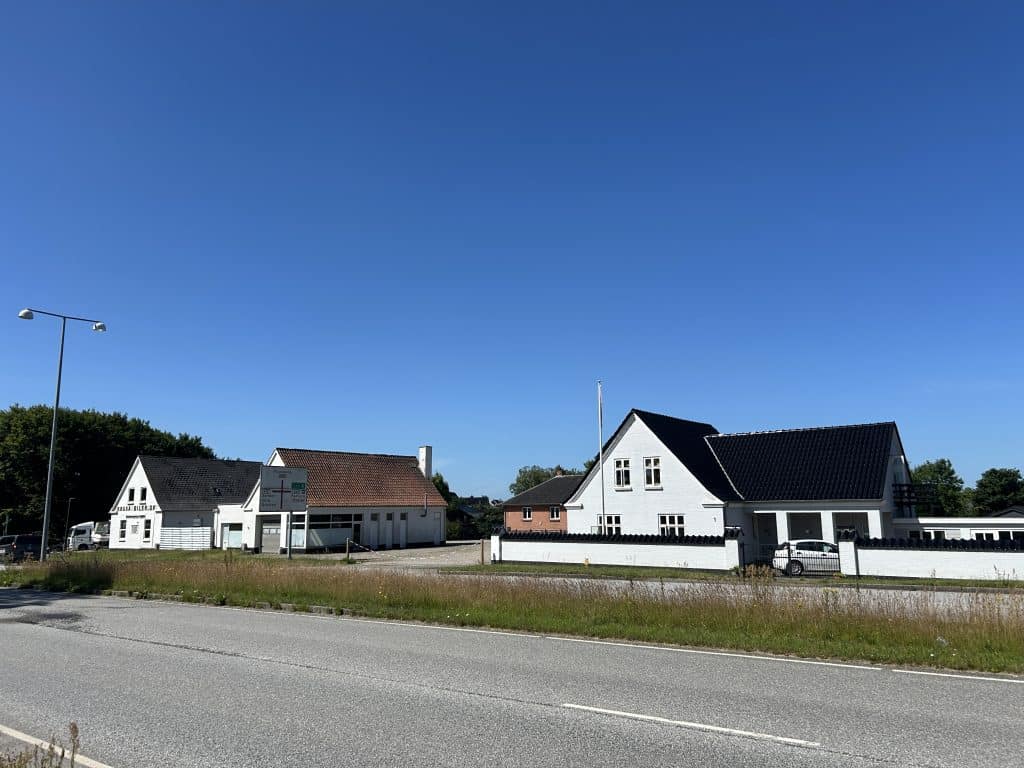
Kruså is a town in Southern Jutland (Sønderjylland), Denmark. It is located directly on the Danish-German border and is part of Aabenraa Municipality. The town is situated just north of the German city of Flensburg, at the inner end of the Flensburg Fjord. With a population of approximately 1,500 residents, Kruså’s primary function is that of a major border crossing point and a center for cross-border trade.
The character of Kruså is defined by its role as a border town. For much of the 20th century, it was the most important road crossing between Denmark and Germany. This has shaped its economy and its landscape. The town is lined with numerous large supermarkets and shops known as grænsebutikker (border shops). These cater primarily to customers from Scandinavia. This commercial function exists alongside its identity as a small Danish town in a rural, forested region.

A Short History of Kruså
The history of Kruså is that of a small village that was transformed into a major national border crossing by the political events of the early 20th century. Before 1920, it was just a small settlement in the German province of Schleswig-Holstein. The establishment of the new border turned it into a key point of entry into Denmark overnight. Its modern history is therefore entirely linked to its function as a border town and a center for the unique phenomenon of cross-border shopping.
A Small Village on a New Border
For centuries, the area of Kruså was a small, unremarkable settlement in the Duchy of Schleswig. The village was located near the Kruså river, from which it gets its name. Its modern history began after World War I. Following the defeat of Germany, the Schleswig Plebiscites of 1920 were held to determine the new border between Denmark and Germany based on the principle of self-determination. The vote resulted in Northern Schleswig returning to Denmark, and the new border was drawn to pass directly by Kruså, placing the village in Denmark.
Growth as a Border Town
The establishment of the new border immediately gave Kruså major strategic importance. It became the primary land entry point into Denmark from Central Europe. A large customs and border control station was built here. This made the town a key hub for all road traffic traveling between Scandinavia and the rest of the continent for several decades. This led to the growth of the town, with new housing and services for the people who worked at the border. The main European route, the E3 (now part of the E45), passed directly through the town.
The Era of Border Shopping
From the mid-20th century onwards, Kruså’s economy became increasingly defined by cross-border trade (grænsehandel). Due to differences in taxes and duties between Denmark and Germany, especially on items like alcohol, confectionery, and soft drinks, it became popular for Danes to drive to the border to shop. This led to the construction of numerous large supermarkets and specialty stores in the area around the border crossing. While the opening of the E45 motorway has diverted much of the long-distance traffic away from the town center, Kruså remains a major center for this specific type of retail.


Things to Do and See
The sights in and around Kruså are focused on its unique border location and the surrounding natural landscape. The main points of interest include the border crossing itself, the historic hiking trail that follows the border, and the nearby forests and fjord.
The Border Crossing
The Kruså border crossing (Grænseovergang Kruså-Kupfermühle) is the primary historical sight. For much of the 20th century, this was the busiest land border crossing into Denmark. The old customs buildings still stand as a reminder of this era before the Schengen Agreement created open borders. A walk across the small bridge over the Kruså river takes you directly from Denmark into the German village of Kupfermühle. The area remains a tangible symbol of the 1920 border settlement and European integration.
The Border Shops
The numerous large border shops (grænsebutikker) are a defining feature of Kruså. These large supermarkets are located directly on the Danish side of the border. They cater almost exclusively to customers from Denmark and other parts of Scandinavia who come to purchase goods at lower prices. Shops like Fleggaard and Calle are major retailers in the region. Observing the scale of this cross-border trade is a unique cultural and economic sight.
Kollund Forest
The Kollund Forest (Kollund Skov) is a large, protected forest located just to the east of Kruså. The forest stretches along the northern shore of the Flensburg Fjord. It is one of the largest forests in this part of Southern Jutland. The area has numerous marked trails for hiking and walking. The paths offer views of the fjord and the German coastline on the other side.
The Gendarmsti
The Gendarmsti (The Gendarme Path) is a famous long-distance hiking trail that passes directly through Kruså. The 84-kilometer-long trail follows the Danish side of the border along the coast of the Flensburg Fjord. The path was historically used by the Danish border guards, the gendarmer, to patrol the border after the 1920 reunification. Today, it is a popular recreational trail that offers scenic views and historical context.
Flensburg Fjord
Kruså is located at the very inner end of the Flensburg Fjord (Flensborg Fjord). This long, narrow inlet of the Baltic Sea forms the maritime border between Denmark and Germany. The area around the fjord is known for its natural beauty, with rolling hills, forests, and small beaches. The fjord is a popular area for sailing and other water sports. The presence of the fjord defines the landscape of the entire region.


Getting Around in Kruså
Navigating the town of Kruså is straightforward and is best done on foot. The town is very small, and its main features—the border crossing and the shops—are all located within a compact area.
On Foot: The Border Area
Walking is the only way to properly explore the immediate border area. Visitors can easily walk from the main shopping centers across the border bridge into the German village of Kupfermühle. The starting point of the Gendarmsti hiking trail is also located in the town. The central part of the town is small and easy to navigate on foot.
Local Buses
Public transport in the region is operated by Sydtrafik. Local and regional buses connect Kruså with other Danish towns in the area, such as Aabenraa and Sønderborg. There are also cross-border bus services that connect Kruså with the main bus and train station in the German city of Flensburg. These buses are the primary mode of public transport for traveling within the region.


How to Get to Kruså
Reaching Kruså is very convenient by road, as it is located directly on the main north-south motorway that connects Scandinavia with Central Europe. It is also accessible by public transport via the nearby German city of Flensburg.
The Open Road: Driving the E45/A7
Driving is the most common and practical way to reach Kruså. The town is located just off the E45 motorway (which is designated as the A7 on the German side). This is the main motorway that runs the length of the Jutland peninsula. The border crossing on the motorway is located just a few kilometers west of Kruså. The old main road runs directly through the town center, serving the original border crossing.
Arriving by Air: Nearby Gateways
The closest major international airport is Billund Airport (BLL) in Denmark, located approximately 110 kilometers away. Another major option is Hamburg Airport (HAM) in Germany, about 170 kilometers away. The smaller Sønderborg Airport (SGD) in Denmark is closer but has very limited connections. From any of these airports, a rental car is the most practical option for completing the journey to Kruså.
Connecting by Coach
Long-distance bus services from companies like FlixBus often have stops in the nearby German city of Flensburg. Flensburg is a major transport hub for the region. From the Flensburg bus station, it is a short journey on a local cross-border bus to reach Kruså. This provides an economical option for reaching the area from other parts of Germany and Denmark.
On Track: A Journey by Rail and Bus
Kruså does not have its own train station. The closest major train station is located in Flensburg, Germany, just a few kilometers away. The Flensburg station is served by frequent Deutsche Bahn (DB) services, including long-distance ICE trains from Hamburg and regional trains. From the Flensburg station, a local bus provides the final connection across the border to Kruså. The closest major Danish train station is in Padborg.
The Sea Route: Arriving by Ferry
There is no direct ferry access to the inland border town of Kruså. International travelers arriving by ferry would likely do so at one of the major ports in Jutland, such as Esbjerg or Frederikshavn. From Germany, the Puttgarden-Rødby ferry is a common route to Denmark. From any of these ferry ports, the final journey to Kruså must be completed by car or a combination of train and bus.
Driving Distances
The driving distance from 10 regional cities, according to Google Maps:
- Flensburg, Germany – 6 kilometers (0 h 10 min)
- Kolding, Denmark – 83 kilometers (1 h 00 min)
- Kiel, Germany – 86 kilometers (1 h 10 min)
- Odense, Denmark – 138 kilometers (1 h 40 min)
- Hamburg, Germany – 165 kilometers (1 h 50 min)
- Aarhus, Denmark – 180 kilometers (1 h 50 min)
- Bremen, Germany – 287 kilometers (2 h 50 min)
- Aalborg, Denmark – 295 kilometers (3 h 00 min)
- Copenhagen, Denmark – 337 kilometers (3 h 40 min)
- Berlin, Germany – 459 kilometers (4 h 50 min)
Looking to Explore more of Denmark and Europe?