
Marksburg, Rhineland-Palatinate | Exploring Germany
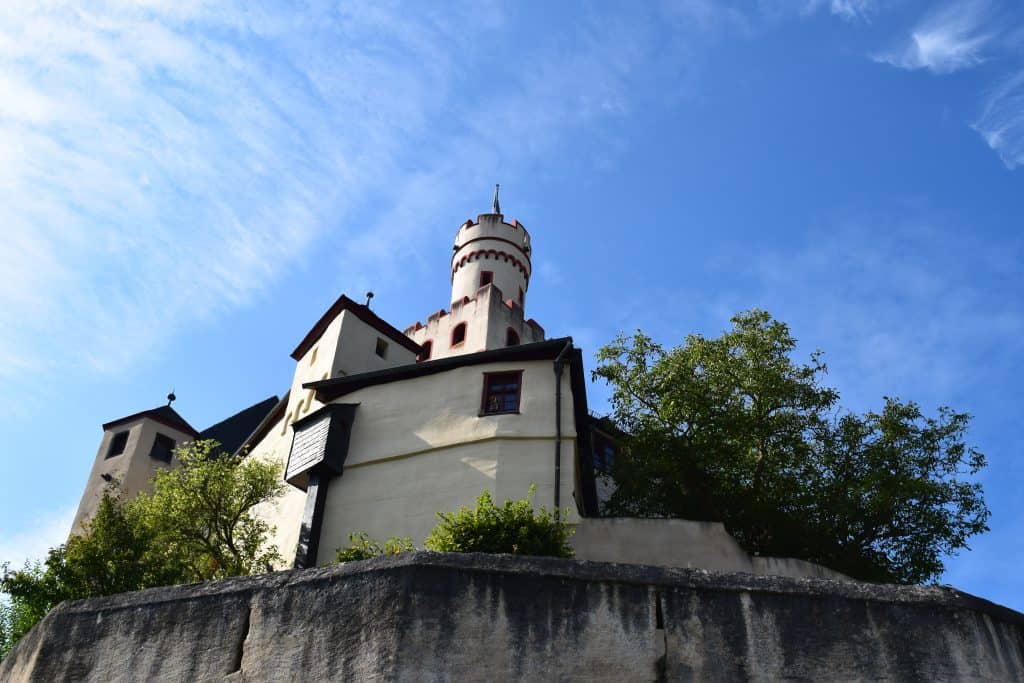
Marksburg is a medieval castle located in the German state of Rhineland-Palatinate. It stands on a conical hill above the town of Braubach, on the right bank of the Rhine River. The castle holds a unique distinction: it is the only medieval castle on the Middle Rhine that has never been destroyed. This makes it a primary site within the Upper Middle Rhine Valley UNESCO World Heritage Site. The castle is located approximately 15 kilometers south of Koblenz.
The character of Marksburg is that of an authentic, preserved medieval fortress. Unlike many other Rhine castles that were ruined and later rebuilt as romantic residences in the 19th century, Marksburg retains its original defensive layout and structures. Its purpose was to protect the town of Braubach and to control the river. Today, it serves as a major museum and is the headquarters of the German Castles Association. The surrounding region is characterized by steep vineyards and numerous other castles.

A Short History of Marksburg
The history of Marksburg is one of continuous occupation and successful defense for over 700 years. Its story begins in the 12th century as a stone fortress built for security and control of the river. It was later expanded by powerful counts and managed to survive numerous regional conflicts intact. Its unique state of preservation led to its acquisition by the German Castles Association in the 20th century, cementing its role as a key monument of German castle history. This journey from a defensive stronghold to a center for castle preservation defines its past.
Foundation and the Counts of Katzenelnbogen
The history of settlement on the castle hill likely began in the early 12th century. The first written mention of the castle dates to 1231. It was originally built by the noble Eppstein family to protect the town of Braubach and the family’s silver mines. The initial structure was a simple keep and surrounding wall. In 1283, the castle was acquired by the powerful Counts of Katzenelnbogen. They significantly rebuilt and expanded the fortress, adding many of its distinctive Gothic features, including the main residential buildings.
Survival and a Change of Purpose
Unlike most other Rhine castles, Marksburg was never conquered or destroyed by force. Its strategic position on a steep rock, combined with continuous modifications to its defenses, ensured its survival through various conflicts. It successfully withstood the Thirty Years’ War in the 17th century and the later campaigns of King Louis XIV of France. After the line of the Counts of Katzenelnbogen died out, the castle passed to the Landgraves of Hesse. Following the Napoleonic Wars, the region became part of the Duchy of Nassau, and the castle was used as a state prison and a home for disabled soldiers.
Preservation by the German Castles Association
By the end of the 19th century, the castle was in a state of disrepair. In 1900, it was sold for a symbolic price of 1,000 Goldmarks to the German Castles Association (Deutsche Burgenvereinigung). This organization had been founded a year earlier with the specific mission to preserve Germany’s historic castles from further ruin. The association undertook extensive and careful restoration work on Marksburg. Since 1931, the castle has served as the headquarters of the German Castles Association. It sustained only minor damage from artillery fire in 1945 during World War II, ensuring its medieval character remains intact.


Things to Do and See
A visit to the Marksburg Castle offers an experience of an authentic medieval fortress. The castle retains its 12th to 15th-century character, with later additions. Visitors pass through four gates, including a working drawbridge and portcullis, before entering the main complex. The slender square-shaped keep, built in 1239, rises 39 meters high and features a distinctive “butter-churn tower” that was later added on top. Defensive features like arrow slits and machicolations, which were openings for dropping objects on attackers, are well-preserved throughout the structure. The interiors are furnished to reflect medieval life. Visitors can explore the Knight’s Hall, the castle kitchen with its original fireplace, and the Chapel of Saint Mark, from which the castle gets its name. The castle also features an armory displaying medieval weapons and a “horse-stair,” a steep stone staircase for horses. The castle is accessible via guided tours only.


How to Get to Marksburg
Reaching Marksburg requires travel to the town of Braubach in the Rhine Valley. The castle is located on a hill directly above the town. It is accessible by road and regional rail, with connections from the major transport hub of Koblenz.
The Open Road: Driving to Braubach
Driving to Marksburg offers flexibility for exploring the Rhine Valley’s numerous castles and vineyards. The town of Braubach is located on the B42, a major federal road that runs along the right bank of the Rhine. This road connects to the A61 and A3 motorways. From Frankfurt, the drive is approximately 100 kilometers. From Cologne, it is about 120 kilometers. A designated parking area is located partway up the hill to the castle, from where it is a short uphill walk to the main entrance.
Arriving by Air: Nearby Gateways
Marksburg does not have its own airport. The closest major international airports are Frankfurt Airport (FRA), approximately 120 kilometers away, and Cologne Bonn Airport (CGN), about 110 kilometers away. Another option is the smaller Frankfurt-Hahn Airport (HHN), which is primarily served by low-cost carriers and is roughly 90 kilometers away. From any of these airports, the journey must be completed by train or rental car.
Connecting by Coach
Direct long-distance bus services to the small town of Braubach are limited. Travel by coach would typically involve taking a service from a company like FlixBus to the main bus station in the nearby city of Koblenz. From Koblenz, travelers would then need to transfer to a regional train or a local bus service to complete the short journey to Braubach.
On Track: A Journey by Rail
The town of Braubach has its own railway station, Braubach station. It is located in the town center, at the base of the castle hill. The station is on the East Rhine Railway line, which is served by regional trains (RB). These trains, operated by Deutsche Bahn (DB), provide frequent connections. From Koblenz Hauptbahnhof, the direct train to Braubach takes only about 15 minutes. There are also direct regional trains from Frankfurt. The walk from the Braubach station to the castle is uphill and takes about 20-30 minutes.
The River Route: Arriving by Boat
For a scenic arrival, it is possible to travel to Braubach by riverboat. The town is a stop on the scheduled services of the KD (Köln-Düsseldorfer) Rhine cruise line. These boats connect the various towns and castles along the Middle Rhine Valley, running between Koblenz and Mainz. While not a primary mode of transport from distant cities, it is a popular way to travel between the towns of the UNESCO World Heritage site during the tourist season.
Driving Distances
The driving distance from 10 regional cities, according to Google Maps:
- Frankfurt, Germany – 102 kilometers (1 h 20 min)
- Cologne, Germany – 121 kilometers (1 h 30 min)
- Luxembourg City, Luxembourg – 186 kilometers (2 h 20 min)
- Stuttgart, Germany – 286 kilometers (3 h 10 min)
- Brussels, Belgium – 323 kilometers (3 h 40 min)
- Amsterdam, Netherlands – 380 kilometers (4 h 10 min)
- Munich, Germany – 512 kilometers (5 h 20 min)
- Hamburg, Germany – 542 kilometers (5 h 30 min)
- Paris, France – 575 kilometers (6 h 00 min)
- Berlin, Germany – 606 kilometers (6 h 10 min)
Looking to Explore more of Germany and Europe?