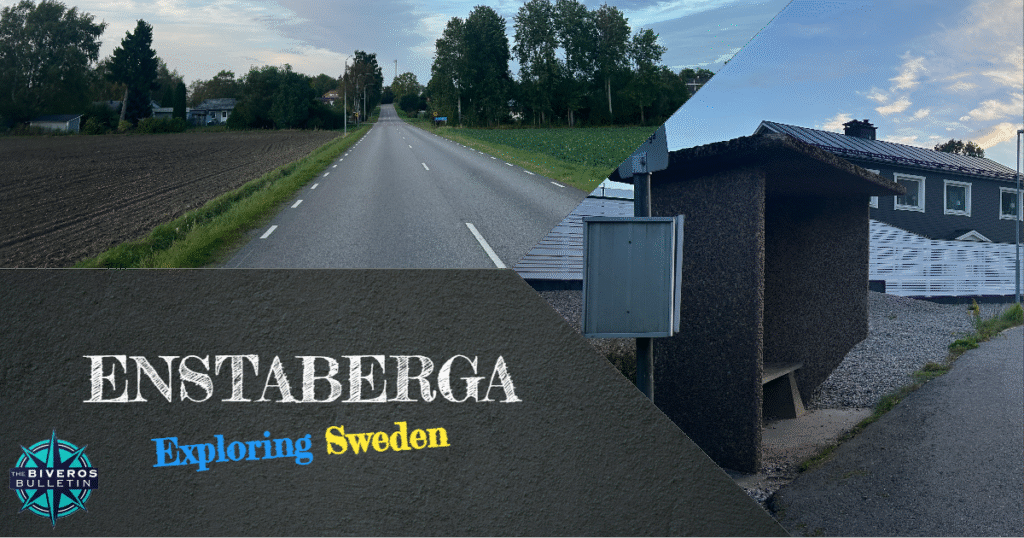
Enstaberga, Södermanland | Exploring Sweden
Enstaberga is a residential locality in the province of Södermanland. It is a part of Nyköping Municipality and is located approximately 10 kilometers west of the city of Nyköping. The community lies within the historical Tuna parish, surrounded by a landscape of forests and agricultural land. The locality’s development is directly connected to the construction of the railway in the late 19th century, which established a new center of activity in the rural parish. The community that grew around this new transport link forms the core of the settlement that exists today.
The primary function of Enstaberga today is that of a commuter locality. Many of its residents work in the greater Nyköping area, making use of the close proximity and good road connections to the city. While it is a small community, Enstaberga has its own essential services, including a school, a grocery store, and other small businesses that support daily life. The locality offers a quiet, countryside living environment while remaining well-connected to the amenities of a larger urban center.


History of Enstaberga
The history of the modern locality of Enstaberga is that of a classic Swedish stationssamhälle, or railway community. Before the arrival of the train, the area was a rural landscape of farms belonging to the ancient Tuna parish, whose center was the medieval church located several kilometers away. The establishment of a railway station in the late 19th century created an entirely new hub for commerce, transport, and settlement. This new community quickly surpassed the old church village in importance, growing into the primary settlement in the area and shaping the region’s development throughout the 20th century.
The Pre-Railway Era
For centuries, the area where Enstaberga now stands was sparsely populated farmland. It was part of the historical Tuna parish, a large agricultural district with roots stretching back to the early medieval period. Life revolved around the parish church and the work on the surrounding farms and manors. The name Enstaberga was originally the name of a farm in the area. This quiet, agrarian way of life was typical for the Södermanland countryside and remained largely unchanged until the arrival of the industrial revolution and its transformative infrastructure projects.
The Arrival of the Railway
The pivotal event in Enstaberga’s history was the construction of the Västra stambanan (the Western Main Line), one of Sweden’s primary railway lines. A station was opened here in 1862, primarily to serve the surrounding agricultural district and the nearby Tuna brickworks. The station building, along with a post office and a general store, formed the nucleus of a new community. The railway provided an efficient way to transport goods, such as grain and timber from the local farms, to the rest of the country. This new economic opportunity attracted craftsmen, merchants, and workers, who began to build homes near the station.
Development as a Service Locality
Throughout the first half of the 20th century, Enstaberga grew into a small but bustling service center for the surrounding parish. It had several shops, a local dairy, and other small businesses that supported the agricultural economy. However, as road transport became more dominant, the railway’s local importance declined, and passenger services to the station eventually ceased in 1971. The town then transitioned into its modern role as a residential commuter locality, with its excellent location near Nyköping and the E4 motorway ensuring its continued relevance and growth as a desirable place to live.


Sights at Enstaberga
As a small community that developed in the 20th century, the sights in Enstaberga are focused on its connection to the surrounding historical landscape and its origins as a railway village. The locality itself has few distinct landmarks, with the main points of interest being the historical parish church and the remnants of the railway that created the community. Exploring the area is an opportunity to see the relationship between an ancient parish and the small settlement that grew from it.
Tuna Church
Tuna Church (Tuna kyrka) is the most significant historical building in the area, located a few kilometers from the center of Enstaberga. The church is the historical heart of the Tuna parish and has medieval origins, with parts of the structure dating back to the 12th century. It is a well-preserved stone church with a whitewashed exterior and a separate wooden bell tower from the 17th century. The church is surrounded by a large cemetery and contains historical artifacts, including a notable medieval wooden sculpture. A visit provides a direct connection to the area’s deep agricultural past.
Read More Here: Tuna, Södermanland | Exploring Sweden
The Former Railway Station Area
Although passenger trains no longer stop in Enstaberga and the original station building has been converted into a private residence, the railway area remains the historical core of the locality. The main railway line still runs directly through the community, and the layout of the central streets clearly reflects the town’s origins as a stationssamhälle. The old station house and the nearby warehouse buildings are important historical landmarks. They represent the period of growth in the early 20th century that transformed Enstaberga from a simple farm name into a thriving community.


How to Get to Enstaberga?
Reaching Enstaberga is straightforward due to its proximity to Nyköping and the main transport routes of Södermanland. The locality is located just a short distance from the E4 motorway and is also very close to Stockholm Skavsta Airport. This excellent connectivity makes it easily accessible for both domestic and international travelers. The journey to Enstaberga almost always involves traveling via Nyköping, from which the final leg of the journey is a short trip by car or local bus.
The most common way for visitors to travel to Enstaberga is to first arrive in Nyköping, which serves as the gateway to the region. Nyköping is well-connected by train, bus, and air. From the Nyköping travel center (resecentrum), which includes both the train and bus stations, frequent local buses make the short journey west to Enstaberga. For those driving, the main roads leading out of Nyköping towards Enstaberga are clearly signposted.
Driving to Enstaberga
The most direct way to get to Enstaberga is by car. From the E4 motorway, travelers should take exit 132 (Nyköping V) and then follow road 52 westward for approximately 7 kilometers. The drive from the motorway exit to the center of the locality takes about 10 minutes. From central Stockholm, the total driving time is approximately 1 hour and 20 minutes. A car is the most flexible option and is highly recommended for exploring the area.
Reaching Enstaberga by Train
The closest train station to Enstaberga is Nyköping Central Station. The station is located on the main line and has regular train services connecting it with Stockholm, Norrköping, and Linköping. From Stockholm, the train journey to Nyköping takes about one hour. Upon arrival at Nyköping station, travelers can take a local bus from the adjacent bus terminal for the final 15-minute journey to Enstaberga.
Nearby Airports and Flights
Enstaberga is located very close to Stockholm Skavsta Airport (NYO), one of Sweden’s main hubs for low-cost airlines. The airport is only about a 15-minute drive from Enstaberga, making it an exceptionally convenient gateway for international visitors. Airport buses connect the airport with Nyköping’s central bus station, from where one can transfer to a local bus to Enstaberga. The main international airport, Stockholm Arlanda (ARN), is approximately a two-hour drive away.
Traveling to Enstaberga by Bus
Long-distance bus companies like Flixbus operate routes to Nyköping from many cities in Sweden. These buses arrive at the Nyköping bus terminal, located next to the train station. From there, it is a simple transfer to the local bus service operated by Sörmlandstrafiken for the final short journey to Enstaberga. This combination of long-distance and local bus is often the most budget-friendly travel option.
Driving Distances
The driving distance from 20 regional cities, according to Google Maps:
- Nyköping, Sweden – 11 kilometers (0 h 12 min)
- Oxelösund, Sweden – 23 kilometers (0 h 22 min)
- Katrineholm, Sweden – 46 kilometers (0 h 40 min)
- Norrköping, Sweden – 65 kilometers (0 h 45 min)
- Eskilstuna, Sweden – 79 kilometers (1 h 5 min)
- Södertälje, Sweden – 86 kilometers (0 h 55 min)
- Linköping, Sweden – 107 kilometers (1 h 15 min)
- Stockholm, Sweden – 121 kilometers (1 h 25 min)
- Västerås, Sweden – 126 kilometers (1 h 40 min)
- Örebro, Sweden – 129 kilometers (1 h 45 min)
- Uppsala, Sweden – 191 kilometers (2 h 10 min)
- Jönköping, Sweden – 238 kilometers (2 h 35 min)
- Kalmar, Sweden – 296 kilometers (3 h 30 min)
- Gävle, Sweden – 298 kilometers (3 h 5 min)
- Växjö, Sweden – 320 kilometers (3 h 35 min)
- Gothenburg, Sweden – 374 kilometers (4 h 0 min)
- Oslo, Norway – 411 kilometers (4 h 45 min)
- Helsingborg, Sweden – 483 kilometers (4 h 55 min)
- Malmö, Sweden – 534 kilometers (5 h 25 min)
- Copenhagen, Denmark – 576 kilometers (6 h 5 min)
Explore More of Södermanland and Sweden