
Koblenz, Rhineland-Palatinate | Exploring Germany
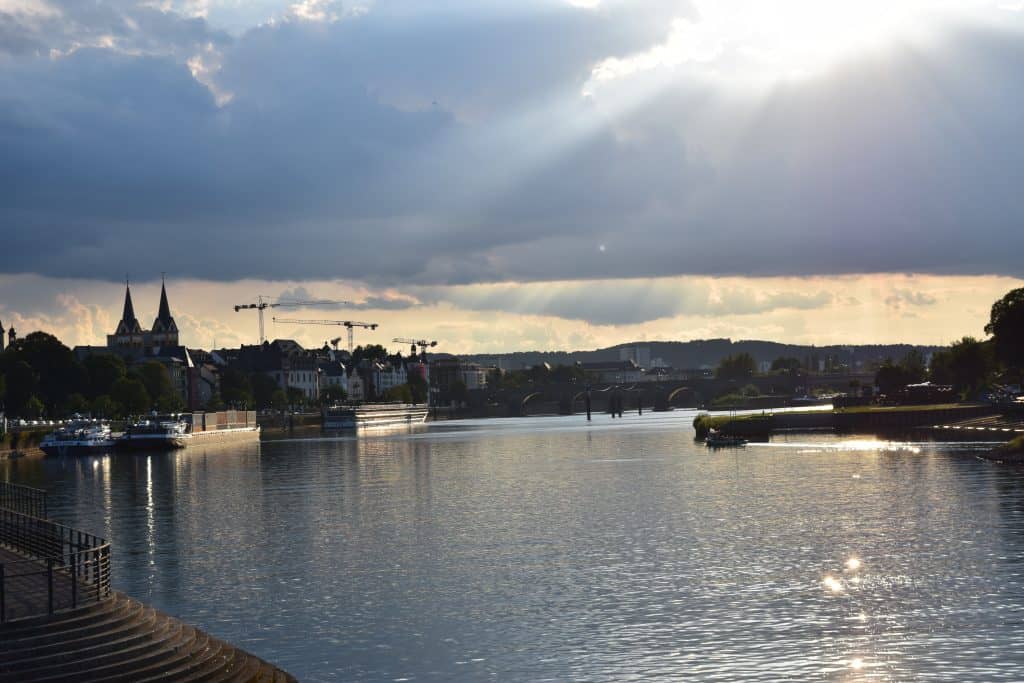
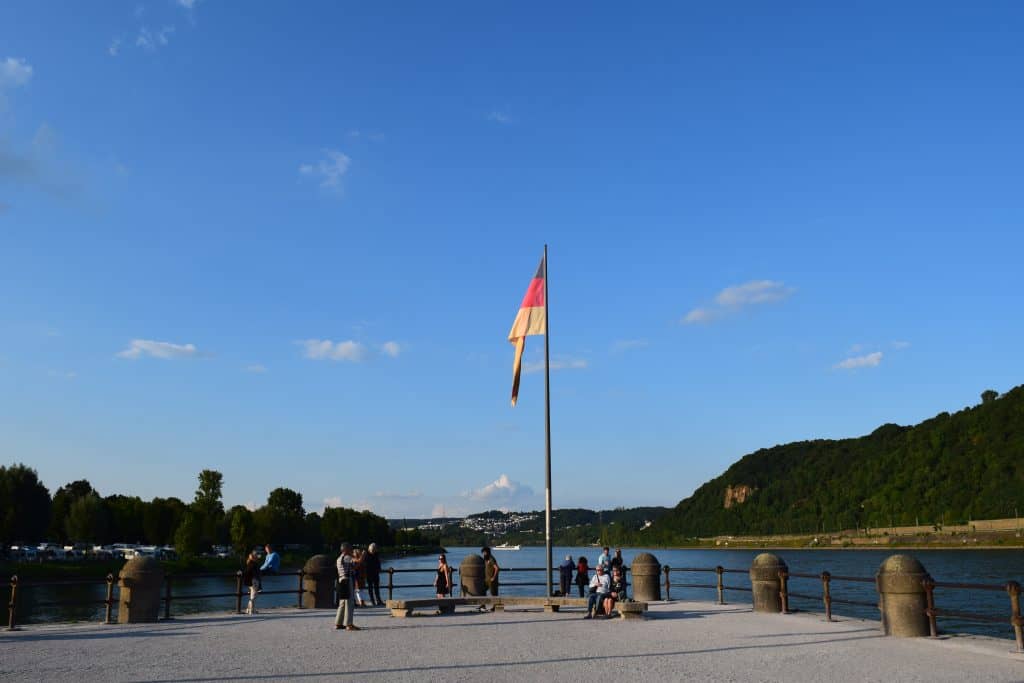
Koblenz is a city in the German state of Rhineland-Pfalatinate. The city is situated at the Deutsches Eck (German Corner), which is the precise confluence of the Moselle and Rhine rivers. With a population of approximately 113,000 residents, it is a key economic and cultural center in the region. Koblenz is surrounded by spurs from four low mountain ranges: the Eifel, the Hunsrück, the Westerwald, and the Taunus. This geographical position has shaped its history and its modern identity. The city is also a gateway to the Upper Middle Rhine Valley UNESCO World Heritage Site.
The character of Koblenz is defined by its 2,000-year history and its location at the meeting point of two major rivers. The city’s landscape is dominated by the Deutsches Eck and the large Ehrenbreitstein Fortress, which overlooks the confluence from the opposite bank of the Rhine. Its Old Town contains historic churches and squares, reflecting its past as an ecclesiastical seat. Its more recent history is evident in the extensive Prussian-era fortifications that encircle parts of the city. Today, Koblenz serves as a major center for tourism, business, and administration in the region and is a key hub for the Moselle and Rhine wine-producing areas.
A Short History of Koblenz
The history of Koblenz is that of a strategic settlement whose destiny has always been shaped by its location at the meeting point of two major rivers. Its story begins as a Roman military outpost, evolves into the seat of a powerful ecclesiastical ruler, and later becomes a key Prussian fortress city. This long history has placed it at the center of many regional conflicts and has left a layered architectural and cultural heritage. The city has been rebuilt and refortified multiple times over the centuries. This has resulted in a city that showcases elements from many different periods of German history.
Roman Confluentes and Ecclesiastical Rule
The history of Koblenz began around 8 BC when Roman forces under the commander Drusus established a military post here. They named the settlement “Confluentes,” a Latin term meaning “at the confluence,” referring to the meeting of the Rhine and Moselle rivers. The Romans built bridges over both rivers, and the settlement grew into an important commercial town within the province of Germania Superior. The site was fortified and remained a key Roman stronghold for several centuries.
After the fall of the Roman Empire, it became part of the Frankish kingdom. In 1018, the German Emperor Henry II granted the city to the Archbishops of Trier, who would rule the city for nearly 800 years as Prince-Archbishops. During this long period of ecclesiastical rule, Koblenz grew in importance. Major churches like the Basilica of St. Castor were expanded, and the city became a key administrative center for the Electorate of Trier.
French Occupation and Prussian Fortress
During the late 18th century, the city’s history was impacted by the French Revolution. Koblenz became a major gathering point for French royalists and nobles fleeing the revolution in France. In 1794, the city was captured by French Revolutionary troops. It later served as the capital of the French Département de Rhin-et-Moselle until the fall of Napoleon in 1814. This period brought French administrative systems and legal codes to the city.
After Napoleon’s defeat, the Congress of Vienna awarded the city to the Kingdom of Prussia in 1815. The Prussians recognized its strategic importance and developed Koblenz into one of their most powerful fortress cities. They constructed an extensive system of fortifications around the city in the 19th century. This included the massive rebuilding of the Ehrenbreitstein Fortress on the eastern bank of the Rhine, creating one of the most formidable strongholds in Europe at the time.
World Wars and Modern City
During the 19th century, Koblenz became the capital of the Prussian Rhine Province, a role that brought new administrative buildings and a large military garrison to the city. Its fortifications were eventually decommissioned in the late 19th century, allowing the city to expand. In the 20th century, the city suffered heavy damage from Allied bombing raids during World War II. Approximately 87% of the city was destroyed, including much of its historic Old Town.
After the war, a major rebuilding effort was undertaken. This restored much of its historic architecture while also integrating modern elements. Koblenz served as the seat of government for the new state of Rhineland-Palatinate from 1946 until 1950, when the capital was moved to Mainz. Today, it is a major center for tourism, business, and federal institutions, including the German Army Command.
Things to Do and See
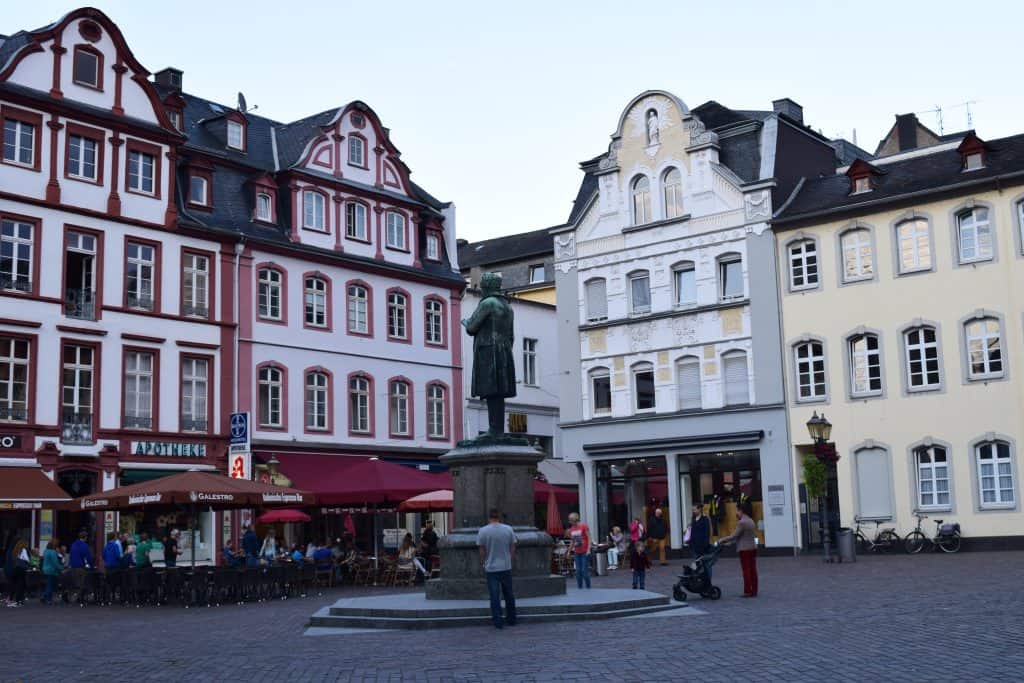
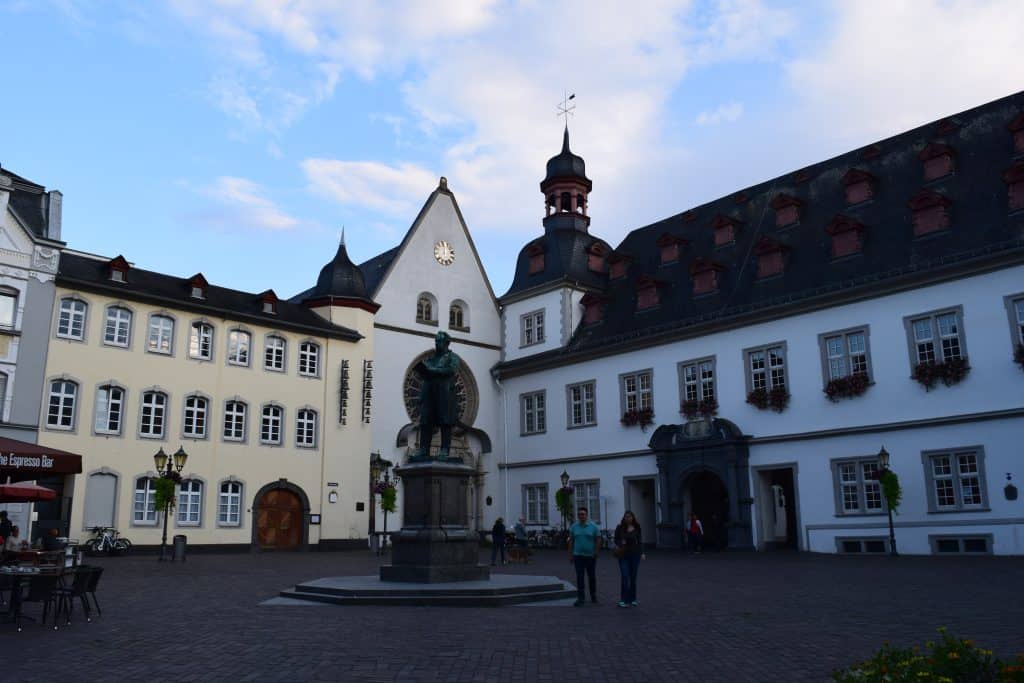
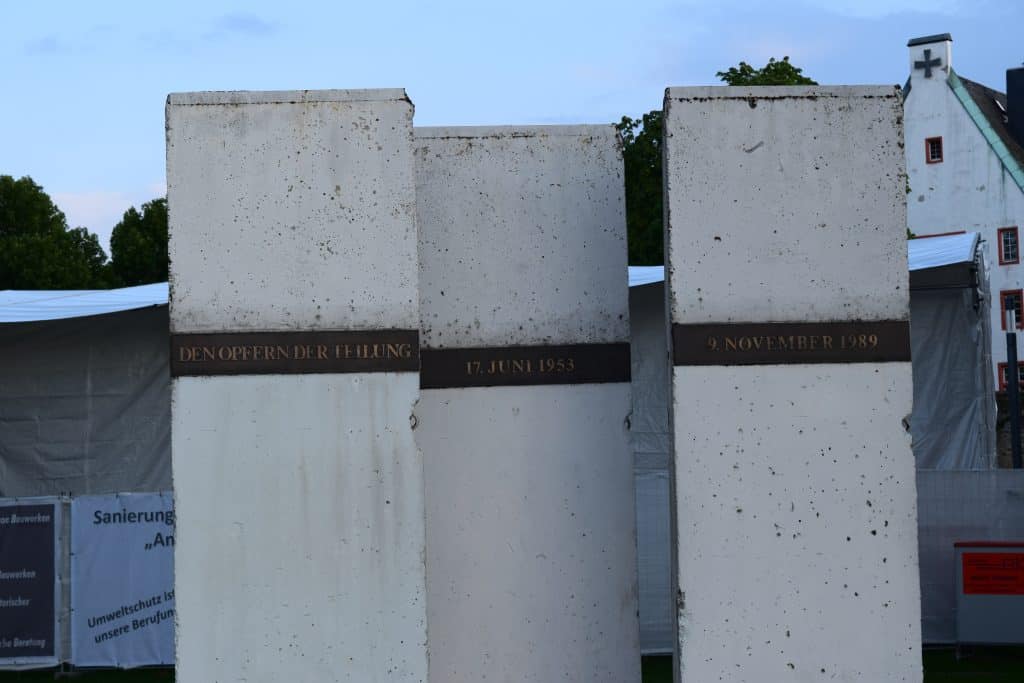
Koblenz offers a range of attractions that showcase its history, geography, and architecture. Visitors can explore the Deutsches Eck, where the two rivers meet, and ascend to the Ehrenbreitstein Fortress for panoramic views. A number of historic palaces and churches are located within the city. The city is also home to several museums that explore the region’s history and culture. These sights are mostly concentrated in the walkable Old Town and along the riverbanks.
Deutsches Eck
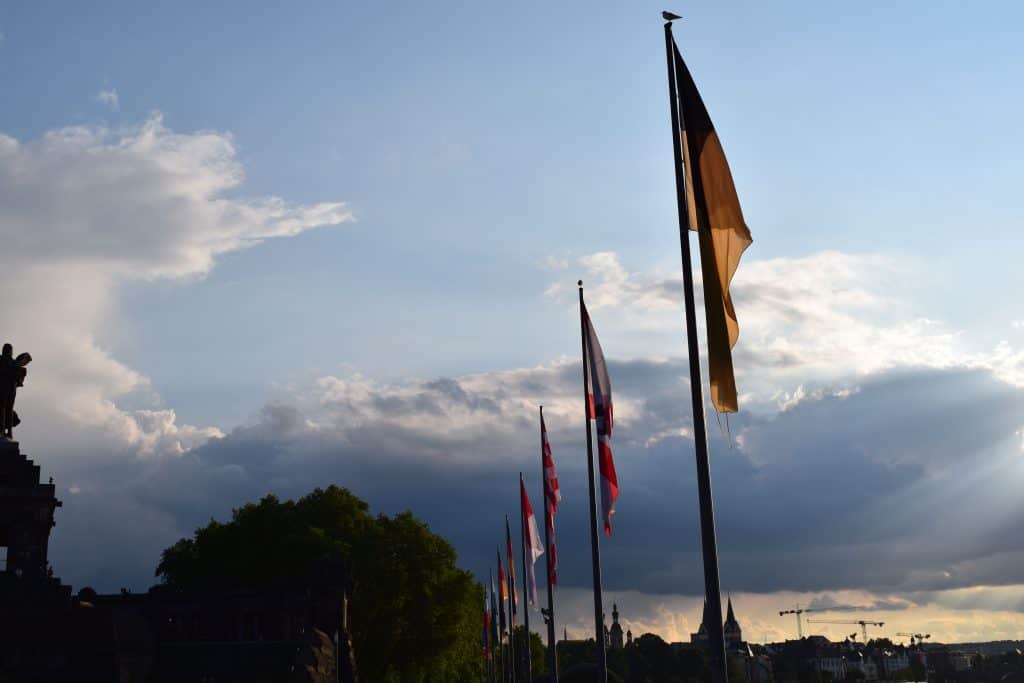
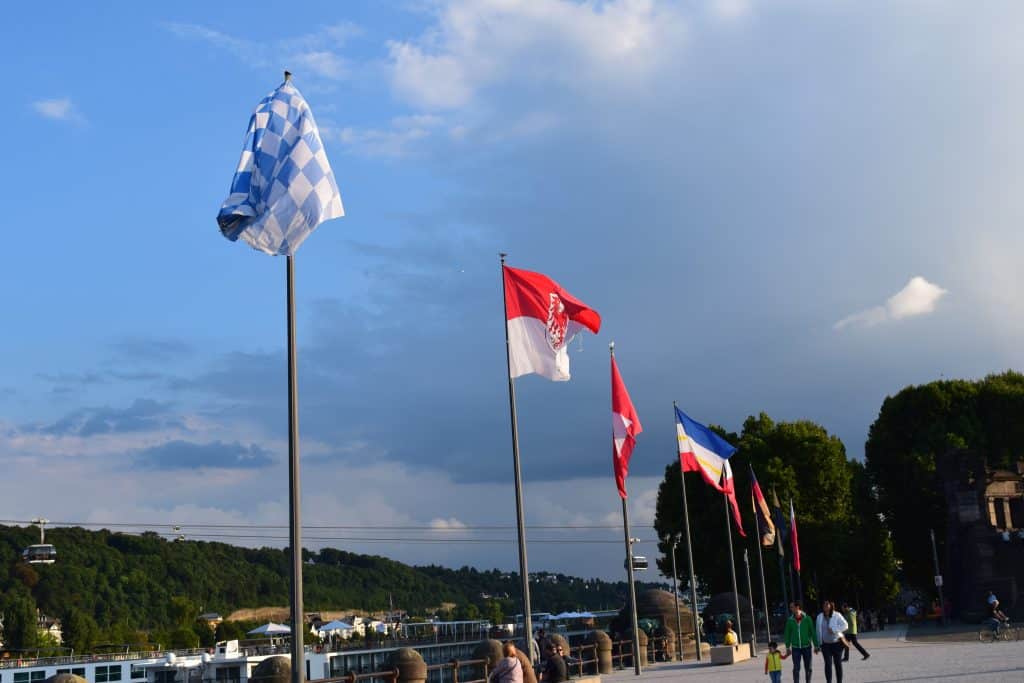
The Deutsches Eck is Koblenz’s most famous landmark. It is the precise point where the Moselle River flows into the Rhine. This headland features a large monument to Emperor Wilhelm I, which was completed in 1897 as a symbol of German unification. The original equestrian statue was destroyed in World War II. A replica was installed in 1993, and the monument now serves as a symbol of German reunification. The site has been part of the Upper Middle Rhine Valley UNESCO World Heritage Site since 2002. The flags of all 16 German states fly at the monument.
Festung Ehrenbreitstein
The Ehrenbreitstein Fortress (Festung Ehrenbreitstein) is the second-largest preserved fortress in Europe. It stands 118 meters above the Rhine, offering panoramic views of Koblenz and the Deutsches Eck. Its origins date back to around the year 1000. The current structure was built by the Prussians between 1817 and 1828. Today, it houses the State Museum of Koblenz (Landesmuseum Koblenz), with exhibitions on technology, archaeology, and fortress history. It also contains a youth hostel and restaurants. Visitors can reach it via a scenic cable car ride across the Rhine.
Schloss Stolzenfels
Stolzenfels Castle (Schloss Stolzenfels) is a key example of Rhine Romanticism architecture. Located just a few kilometers south of the Koblenz city center, this 19th-century palace was rebuilt from the ruins of a 13th-century toll castle. It was a gift from the city to the Prussian Crown Prince Friedrich Wilhelm in 1823. The castle was redesigned by the famous architect Karl Friedrich Schinkel. Its park and gardens are also notable. The castle showcases 19th-century residential culture and is part of the UNESCO World Heritage site.
Kurfürstliches Schloss
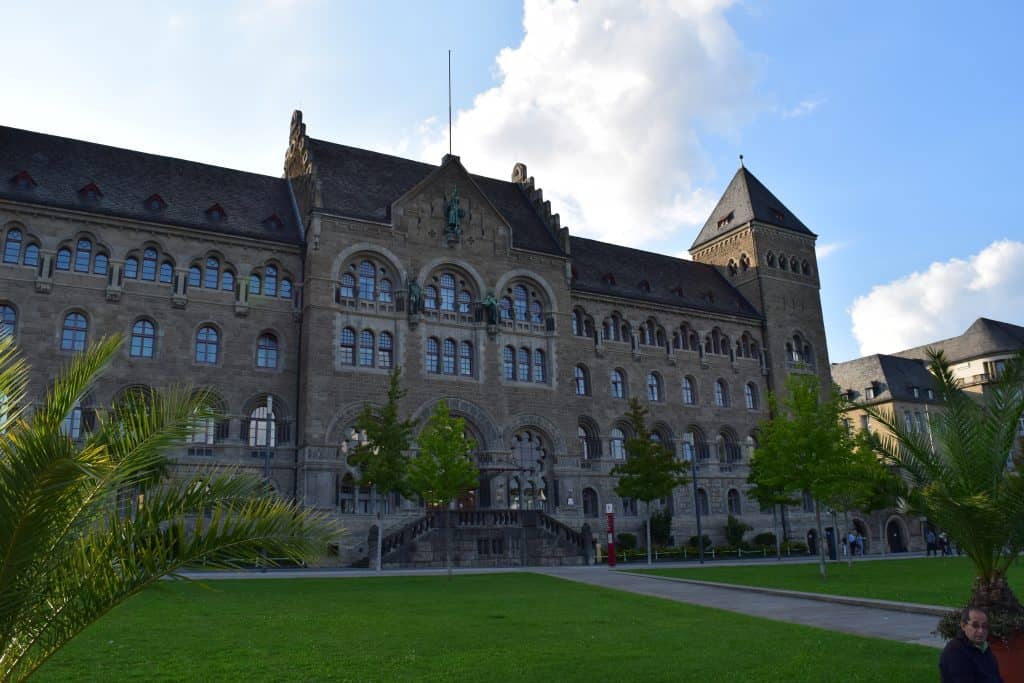
The Electoral Palace (Kurfürstliches Schloss) is one of the most important palace buildings of early French Classicism in southwest Germany. Built between 1777 and 1786, it was the residence of the last Archbishop and Elector of Trier, Clemens Wenceslaus of Saxony. In the mid-19th century, it served as the official residence for Prussian royalty, including the later Emperor Wilhelm I. The palace was heavily damaged in 1944 but was rebuilt. Its terrace garden facing the Rhine is freely accessible to the public. The palace itself now houses various federal government offices.
Liebfrauenkirche
The Liebfrauenkirche is a Catholic church located in Koblenz’s Old Town. Its history dates back to the 5th century, with predecessors built on Roman foundations. The current building is primarily a late Romanesque basilica from around 1205, with a later Gothic choir. Its distinctive onion domes were added in the 17th century after the previous spires were destroyed. The church suffered heavy damage during World War II but was meticulously rebuilt. It is also part of the UNESCO World Heritage site.
Basilika St. Kastor
The Basilica of St. Castor (Basilika St. Kastor) is the oldest church in Koblenz, with origins dating back to the 9th century. It stands near the Deutsches Eck. The current impressive Romanesque basilica was built between 817 and 836. It served as a significant site for medieval negotiations; the Treaty of Verdun, which divided the Carolingian Empire, was prepared here in 842. The church features a cloister and a rich interior. It is part of the UNESCO World Heritage site.
Romanticum Museum
The Romanticum is an interactive multimedia museum. It is located in the Forum Confluentes building in the city center. The museum offers a journey through the Upper Middle Rhine Valley UNESCO World Heritage Site. It presents the region’s history, legends, and landscapes. The museum uses projections and soundscapes to create an engaging experience. It highlights the castles, vineyards, and historical significance of the Rhine Gorge. It provides an excellent introduction to the region for visitors.
Sports in Koblenz
The sporting life in Koblenz is focused on its main community football club, as well as several other sports that have a strong regional presence. The city’s location on two major rivers and its proximity to mountain ranges also provide extensive opportunities for outdoor recreational activities like hiking and cycling. While the city itself is not home to a top-tier team in Germany’s major leagues, its clubs are an important part of the local identity. The city has facilities like the Stadion Oberwerth and the CGM Arena that can host national-level events. This creates an active environment for both participants and spectators throughout the year.
Football
Football holds a significant place in Koblenz’s community, as it does throughout Germany. The city’s primary football club has a long history and commands a loyal local following from the city and the surrounding region. Matches are important social events that unite generations of fans and foster a strong sense of local identity. The club provides a platform for local players and serves as a point of social gathering for its supporters. The team represents Koblenz in the German national league system.
TuS Koblenz
TuS Koblenz is the city’s most prominent football club. The club has a history that includes periods of competing at a higher level in the German league system, including several seasons in the 2. Bundesliga, the second tier of German football. They currently compete in the Regionalliga Südwest, which is the fourth tier. The team plays its home matches at the Stadion Oberwerth, a multi-purpose stadium located on the banks of the Rhine River. The club has a dedicated fanbase and is a key institution for football in the Rhineland-Palatinate region.
Ice Hockey
While not located directly in Koblenz, ice hockey has a notable presence in the nearby city of Neuwied, which is approximately 20 kilometers away. Many Koblenz residents support this regional team, as it is the closest high-level ice hockey club. The sport is popular in Germany, and the team’s games are an important part of the regional sports scene during the winter months. The club has a history of success that has given it a strong identity in the area.
EHC Neuwied
The ice hockey club EHC Neuwied, nicknamed “Die Bären” (The Bears), is based in nearby Neuwied. They have a proud history, which includes winning the 2. Bundesliga twice in 1997 and 1998. The club competes in the Oberliga, which is a high level of German ice hockey, part of the third tier of the sport. They play their home games at the Ice Arena Neuwied, which attracts supporters from across the region, including many from Koblenz.
Tennis
Koblenz has a presence in professional tennis, as it hosts an annual international tournament. This event attracts professional players from around the world to the city. The tournament is part of the ATP Challenger Tour, which is a series of events that serve as a stepping stone for players trying to reach the main ATP Tour. Hosting such an event highlights the city’s capacity to organize significant international sporting competitions. It provides local tennis fans with an opportunity to see high-level professional tennis.
Koblenz Open
The Koblenz Open is an annual professional tennis tournament for male players. It is part of the ATP Challenger Tour. The tournament takes place indoors on hardcourts, usually in January or February. It attracts a strong field of international tennis talent who are competing for ranking points and prize money. The matches are held at the CGM Arena, a versatile indoor venue in the city that is set up specifically for the tournament each year.


Getting Around in Koblenz
Navigating Koblenz is straightforward due to its compact city center. Most of the major Roman and medieval sights are located within a large pedestrian zone, making them easily accessible on foot. For destinations further afield, the city has an efficient public bus network. The presence of two rivers also means that ferries and riverboats are part of the transport mix, particularly for tourism. The city’s layout makes it very suitable for exploration.
On Foot: The Old Town and Riverfronts
Walking is the best way to explore the central part of Koblenz. The Altstadt (Old Town), the Deutsches Eck, and the promenades along both the Rhine and Moselle rivers are all easily accessible on foot. Most of the main sights are located within this compact area. Comfortable shoes are recommended for exploring the historic cobblestone streets. The walk along the river from the Basilica of St. Castor to the Electoral Palace is a key route.
Local Buses
The public transport in Koblenz is operated by koveb. A comprehensive network of local buses serves all parts of the city and its suburbs. The buses are the primary mode of transport for connecting the city center with the main train station and attractions located further afield. The main bus hub is located at the Hauptbahnhof (main train station). The local transport authority is the Verkehrsverbund Rhein-Mosel (VRM), which offers integrated tickets for the wider region.
How to Get to Koblenz
Reaching Koblenz is convenient by road, rail, and river. Its location at the confluence of the Rhine and Moselle makes it a key transport hub in western Germany. It is well-connected to the German and wider European transport networks. The city’s accessibility is a key factor in its importance as a tourist and business destination. The combination of motorway access, a major train station, and its position on two navigable rivers makes it easy to reach. This has been true for centuries, from Roman times to the modern era.
Arriving by Air: Nearby Gateways
Koblenz does not have its own major commercial airport. The closest international airport is Cologne Bonn Airport (CGN), located approximately 90 kilometers away. Frankfurt Airport (FRA), a major international hub, is about 125 kilometers from Koblenz. Another option is Frankfurt-Hahn Airport (HHN), which serves low-cost carriers and is about 50 kilometers away. From any of these airports, onward travel typically involves train or bus services to reach Koblenz. Direct trains connect from both Frankfurt and Cologne airports.
The Open Road: Driving the Motorways
Driving to Koblenz offers flexibility for exploring the Rhine and Moselle valleys. The city is located at a key junction of the German motorway network (Autobahn). The A61 motorway (north-south) and the A48 motorway (east-west) intersect near the city. The A3 motorway also passes nearby. These highways provide direct connections to major cities like Cologne, Frankfurt, and Luxembourg. The B9 federal road is a scenic route that runs along the west bank of the Rhine.
Connecting by Coach
Long-distance bus services provide an economical way to reach Koblenz. The main bus stop area is located near the Koblenz Hauptbahnhof (central train station). Companies like FlixBus operate frequent routes that connect Koblenz with major cities across Germany and Europe. Direct connections are available from Frankfurt, Cologne, and Luxembourg, among others. These services provide a comfortable and affordable alternative to train travel.
On Track: A Key Railway Hub
Traveling to Koblenz by train is highly efficient. The Koblenz Hauptbahnhof is a major railway station and a key hub on the German rail network. It is an Intercity-Express (ICE) stop. High-speed ICE and IC (Intercity) trains provide frequent connections. Direct services run from major cities like Cologne, Frankfurt, Mainz, and Hamburg. Regional trains also serve the scenic routes along the Rhine and Moselle rivers. The station is located a short walk from the city center.
The River Route: Arriving by Boat
For a scenic arrival, it is possible to travel to Koblenz by riverboat. The city is a major stop on Rhine River cruises. Companies like KD (Köln-Düsseldorfer) offer scheduled services that connect Koblenz with other towns and castles along the Middle Rhine Valley. While not a primary mode of transport from distant cities, it is a popular way to arrive if you are already exploring the river. You can embark at towns like Mainz or Rüdesheim.
Driving Distances
The driving distance from 10 regional cities, according to Google Maps:
- Cologne, Germany – 95 kilometers (1 h 10 min)
- Frankfurt, Germany – 128 kilometers (1 h 30 min)
- Luxembourg City, Luxembourg – 150 kilometers (2 h 00 min)
- Stuttgart, Germany – 285 kilometers (3 h 10 min)
- Brussels, Belgium – 299 kilometers (3 h 20 min)
- Amsterdam, Netherlands – 359 kilometers (4 h 00 min)
- Munich, Germany – 507 kilometers (5 h 10 min)
- Hamburg, Germany – 535 kilometers (5 h 20 min)
- Paris, France – 546 kilometers (5 h 40 min)
- Berlin, Germany – 601 kilometers (6 h 10 min)
Looking to Explore more of Germany and Europe?