

Corinth Canal, Peloponnese | Exploring Greece
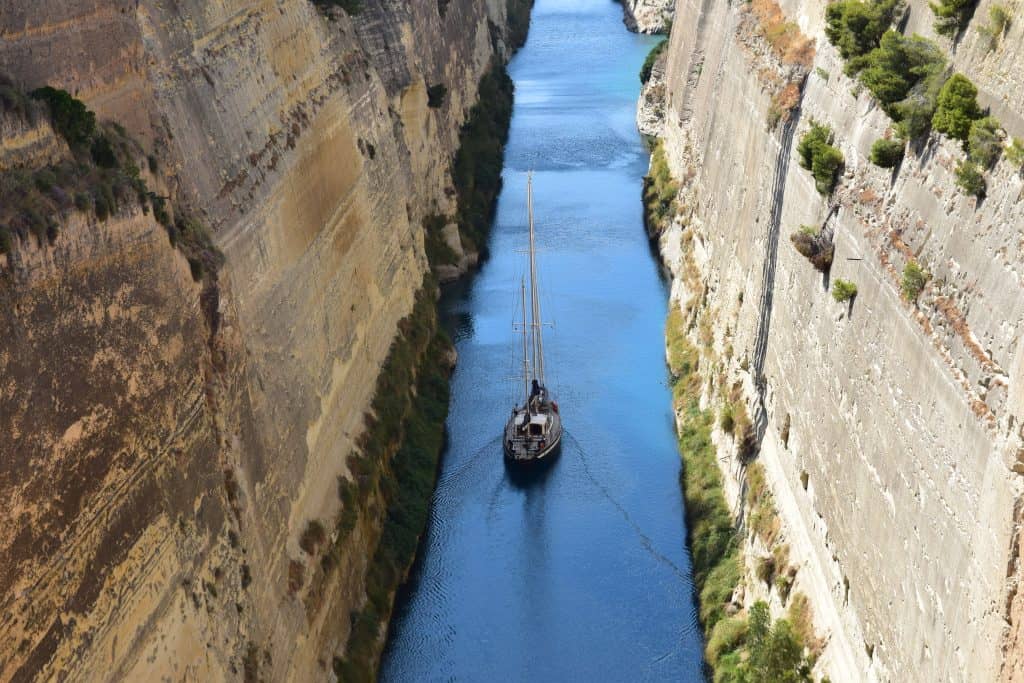
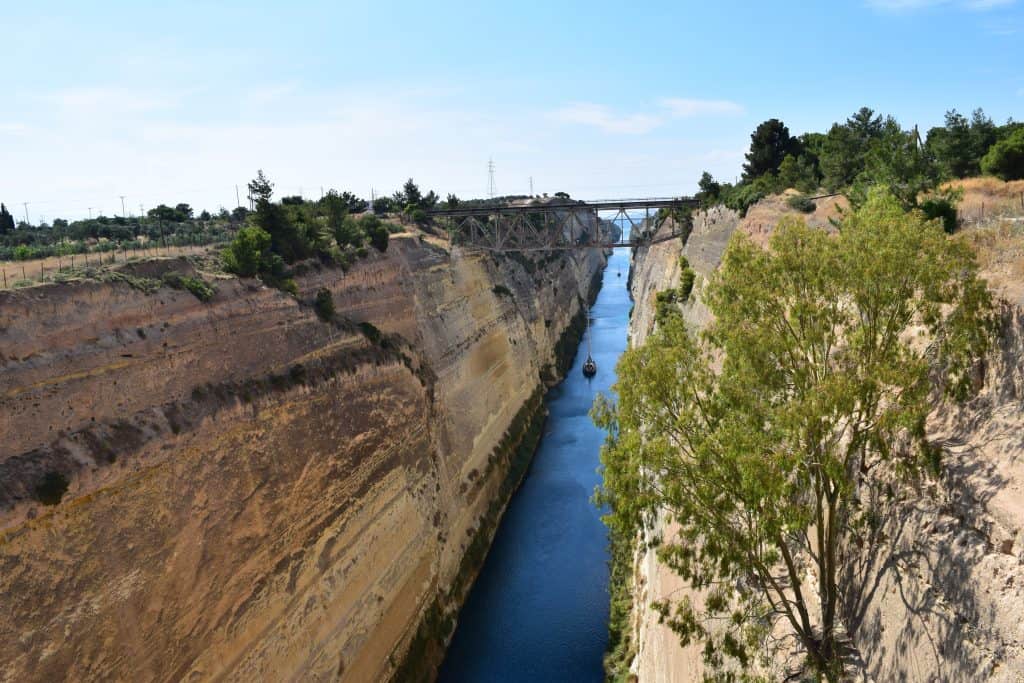
The Corinth Canal is an artificial waterway in Greece that connects the Gulf of Corinth in the Ionian Sea with the Saronic Gulf in the Aegean Sea. It cuts through the narrow Isthmus of Corinth, a strip of land that separates the Peloponnese peninsula from the Greek mainland. This feat of engineering effectively turns the Peloponnese into an island. The canal is 6.4 kilometers long, and its steep limestone walls rise dramatically from the water, creating a stunning and unique landscape.
The canal’s identity is that of a monumental project with ancient roots, a dream of rulers for centuries that was only realized in the modern era. The idea of cutting through the isthmus was first proposed in antiquity. However, the technical challenges prevented its construction until the late 19th century. Today, the canal is too narrow for most modern ships, so its economic importance is limited. It is now primarily a major tourist attraction, offering a unique spectacle as boats pass through its deep and narrow channel.


History of Corinth Canal
The history of the Corinth Canal is a story of a long-held ambition that spanned over two millennia. The idea of creating a waterway through the isthmus was first conceived in ancient Greece as a way to avoid the long and dangerous sea journey around the Peloponnese. Several ancient rulers, including the Roman Emperor Nero, attempted to build the canal, but their efforts were ultimately unsuccessful. The project was finally brought to fruition in the late 19th century, a testament to modern engineering and the enduring vision of a connected waterway.
Ancient Attempts
The first to propose the idea of constructing a canal was the tyrant Periander of Corinth in the 7th century BC. However, the immense technical challenges and cost led him to abandon the project. Instead, he built the Diolkos, a paved stone trackway across the isthmus, where ships could be hauled overland. The idea of a canal was later revived by several Roman emperors, including Julius Caesar and Caligula. The most significant ancient attempt was made by Emperor Nero in 67 AD. He used 6,000 Jewish prisoners of war as a workforce, but the project was abandoned after his death.
The Modern Canal
After Greece gained its independence in the 19th century, the idea of building the canal was reconsidered. After several false starts, construction of the modern canal officially began on April 23, 1882, with King George I of Greece in attendance. The project was initially undertaken by a French company, but it faced financial difficulties. A Greek company eventually took over, and after eleven years of construction, the canal was finally completed and inaugurated on July 25, 1893.
A Challenging Operation
The canal has faced operational challenges since its completion. Its narrowness makes navigation difficult for larger ships. The steep limestone walls have also been prone to landslides, which have occasionally blocked the canal for long periods. During World War II, the canal was blocked by the German army with explosives and debris. Today, it has little economic importance for large-scale shipping. It is primarily used by tourist cruise ships, yachts, and small recreational boats, with around 11,000 vessels passing through it annually.
Sights at Corinth Canal
The sights at the Corinth Canal are centered around the impressive engineering marvel itself. The main attraction is the view from the bridges that cross the deep channel, offering a spectacular perspective of the canal’s straight, narrow path and its towering limestone walls. The canal is also known for its unique submersible bridges, which sink below the water to allow boats to pass. For the more adventurous, the canal has become a world-famous location for bungee jumping. The nearby archaeological site of Ancient Corinth and its acropolis, Acrocorinth, provide a rich historical context for a visit.
The View from the Bridges
The most popular way to experience the Corinth Canal is to view it from above. Several bridges cross the canal at a height of about 45 meters. The main road bridge on the old national highway is a popular spot for tourists to stop and take photos. From here, you can get a dramatic view of the entire length of the canal and its sheer, almost vertical walls. It is a particularly impressive sight when a ship is passing through the narrow channel far below.
Submersible Bridges
At each end of the canal, at the harbors of Isthmia in the east and Poseidonia in the west, there are two unique submersible bridges. These bridges were installed in 1988. Instead of lifting or swinging to allow boats to pass, these bridges sink directly below the water’s surface. Watching the bridge submerge as a ship approaches and then reappear after it has passed is a fascinating and unique engineering spectacle. The bridge at Isthmia is the more easily accessible of the two.
Bungee Jumping
For adrenaline lovers, the Corinth Canal has become one of the most famous and popular locations for bungee jumping in Europe. A company operates from the old road bridge that crosses the canal. A jump from the bridge offers a thrilling, high-altitude plunge into the deep and narrow canyon of the canal. The unique and spectacular setting makes it a particularly memorable place for this extreme sport. It is a popular activity for both participants and for the many spectators who gather on the bridge to watch.
Ancient Diolkos
Near the western end of the canal, at the Poseidonia side, you can see the preserved remains of the Ancient Diolkos. This was the paved trackway that was built by the tyrant Periander in the 7th century BC as an alternative to a canal. Ships were hauled out of the water and pulled across the isthmus on wheeled cradles along this stone road. The remains of the Diolkos are a significant archaeological site, and they provide a fascinating look at the advanced engineering capabilities of the ancient Greeks.
Getting Around at Corinth Canal
The Corinth Canal itself is a waterway, but the main viewing areas and attractions are located at its two ends and on the bridges that cross it. The main tourist viewpoint on the old road bridge is best explored on foot. To travel between the two ends of the canal, at Isthmia and Poseidonia, a car or a local bus is necessary. A boat trip is another unique way to see the entire length of the canal from a different perspective.
Exploring by Foot
The main tourist area, located at the Isthmia end of the canal on the old national road, is best explored on foot. You can walk out onto the main bridge to get the classic view down the length of the canal. The area around the bridge is filled with cafes and souvenir shops. It is also possible to walk down to the submersible bridge at this end of the canal to see it in operation. The area is compact and easily walkable.
Using Local Buses
A local bus service, operated by the regional KTEL bus company, connects the modern city of Corinth with the area around the canal at Isthmia. The buses are frequent and the journey is short. This is a convenient and affordable option for those who are traveling by public transport. The bus is the primary way to get from the main train and bus stations in modern Corinth to the canal itself.
Navigating by Car
A car is the most convenient way to explore the Corinth Canal and its surroundings. Having your own vehicle allows you to easily drive to the main tourist viewpoint on the old road bridge. It also makes it simple to visit the submersible bridges at both the Isthmia and the Poseidonia ends of the canal. A car provides the most flexibility for exploring the other sights in the region, such as Ancient Corinth and Acrocorinth. There is ample free parking available at the main tourist area.
How to Get to Corinth Canal?
The Corinth Canal is located on the Isthmus of Corinth in Greece, and it separates the Pelopese peninsula from the mainland. The canal is very easy to reach, for it is located directly on the main motorway that connects the capital city, Athens, with the Peloponnese. The primary gateway for international visitors is Athens International Airport. From Athens, the Corinth Canal is a very popular and straightforward day trip destination, and it is accessible by car, bus, and train.
Arriving by Air
The closest and most convenient airport is Athens International Airport (ATH). This is the largest and busiest airport in Greece, and it is served by numerous airlines with connections to destinations all over the world. The airport is located about a 1.5-hour drive from the Corinth Canal. From the airport, you can rent a car and drive directly to the site. It is also possible to take a suburban train or a bus from the airport to the city of Corinth.
Driving to the Canal
Driving to the Corinth Canal is very straightforward. The site is located just a few kilometers from the main A8 motorway (Olympia Odos). This is the main highway that connects Athens with the city of Patras in the western Peloponnese. You take the exit for Ancient Corinth and then follow the signs for the canal at Isthmia. The roads are well-maintained, and the signage is clear.
Journey by Rail
It is also possible to reach the area by train. The suburban railway, the Proastiakos, runs from Athens International Airport and the main railway station in Athens to the city of Kiato. You would get off at the station for the modern city of Corinth. From the train station in Corinth, you would then need to take a short taxi ride or a local bus to the canal itself, which is located at the area known as Isthmia.
Connecting by Bus
Long-distance buses, known as KTEL, are another excellent option for reaching the area. There are very frequent and comfortable bus services from the Kifissos Bus Terminal in Athens to the bus station at the Isthmus of Corinth. This bus station is located right next to the main tourist viewpoint of the canal. The journey takes about one and a half hours, and this is often the most direct public transport option.
Traveling Through the Canal by Boat
While not a method of arrival to the region, traveling through the canal by boat is a primary tourist activity. Several companies operate tourist boat cruises that take visitors on a full transit of the 6.4-kilometer waterway. These boat trips typically depart from the harbor at Isthmia, near the eastern entrance of the canal. The journey provides a unique and dramatic perspective from water level, allowing passengers to fully appreciate the height of the sheer limestone walls. The transit of the canal is a popular excursion, and it offers a memorable way to experience this feat of engineering up close.
Driving Distances
The driving distance from 20 regional cities, according to Google Maps:
- Corinth, Greece – 6 kilometers (0 h 10 min)
- Nafplio, Greece – 55 kilometers (0 h 50 min)
- Athens, Greece – 80 kilometers (1 h 00 min)
- Tripoli, Greece – 85 kilometers (1 h 00 min)
- Patras, Greece – 135 kilometers (1 h 30 min)
- Sparta, Greece – 145 kilometers (1 h 50 min)
- Olympia, Greece – 195 kilometers (2 h 20 min)
- Ioannina, Greece – 345 kilometers (3 h 30 min)
- Tirana, Albania – 555 kilometers (6 h 30 min)
- Thessaloniki, Greece – 585 kilometers (5 h 40 min)
- Skopje, North Macedonia – 665 kilometers (6 h 40 min)
- Podgorica, Montenegro – 755 kilometers (10 h 00 min)
- Sofia, Bulgaria – 855 kilometers (8 h 30 min)
- Sarajevo, Bosnia and Herzegovina – 955 kilometers (12 h 00 min)
- Belgrade, Serbia – 1105 kilometers (11 h 00 min)
- Istanbul, Turkey – 1155 kilometers (12 h 00 min)
- Zagreb, Croatia – 1255 kilometers (12 h 30 min)
- Rome, Italy – 1305 kilometers (plus ferry)
- Budapest, Hungary – 1355 kilometers (13 h 30 min)
- Ljubljana, Slovenia – 1405 kilometers (14 h 00 min)
Looking to Explore more of Greece and Europe?