
Archaia Korinthos, Peloponnese | Exploring Greece
Archaia Korinthos, or Ancient Corinth, is a village and a major archaeological site located in the Peloponnese region of Greece. It is situated at the northern base of the monolithic hill of Acrocorinth. This was the site of one of the most powerful and wealthiest city-states of the ancient world. With a small modern population, the village now exists in the shadow of its magnificent past. The extensive ruins of the ancient city, which was a major center for trade and culture, are the main attraction for visitors.
The identity of Archaia Korinthos is defined by this rich and layered history. It was a major Greek city-state, and it later became the prosperous capital of the Roman province of Achaea. Its strategic location on the Isthmus of Corinth gave it control over the trade routes between mainland Greece and the Peloponnese. The city was famous for its wealth, its art, and its temples. Today, the archaeological site offers a journey back in time, with its impressive Temple of Apollo, its large Roman forum, and its excellent museum.


History of Archaia Korinthos
The history of Archaia Korinthos is a story of a great commercial power that rose, fell, and was reborn. The site was first inhabited in the Neolithic period, and it grew into a major city-state in ancient Greece. Its strategic location on the isthmus made it a natural center for trade, and it founded wealthy colonies like Syracuse. The city was famously destroyed by the Romans in 146 BC, but it was later rebuilt by Julius Caesar and became the grand capital of a Roman province. It was during this Roman period that St. Paul visited the city, and his letters to the Corinthians are a key part of the Christian New Testament.
The Greek City-State
The area of Ancient Corinth was first inhabited in the Neolithic period, around 6500 BC. It grew into a major city-state in the 8th century BC. Its location on the isthmus, which controlled the land route between northern and southern Greece and the sea routes between the Ionian and Aegean seas, was the key to its wealth. The city became a major commercial and colonial power. It established famous colonies such as Syracuse in Sicily and Corcyra (modern Corfu). The city’s prosperity reached its peak in the 7th and 6th centuries BC under the rule of the tyrants Cypselus and Periander.
Roman Corinth
The city’s independence came to an end when it was conquered and completely destroyed by the Roman general Lucius Mummius in 146 BC. For a century, the site lay in ruins. In 44 BC, Julius Caesar refounded the city as a Roman colony, Colonia Laus Iulia Corinthiensis. The city was rebuilt on a grand scale, with a large forum, temples, and public buildings. It quickly grew to become the prosperous capital of the Roman province of Achaea. It was to this bustling, cosmopolitan Roman city that the Apostle Paul came in the 1st century AD to preach Christianity.
Decline and Modern Excavations
Corinth was later damaged by several earthquakes and invasions, including by the Heruli and the Goths. It continued as an important city during the Byzantine period, but its importance declined. The city was conquered by the Franks, the Venetians, and the Ottoman Turks. A massive earthquake in 1858 completely destroyed the town that existed on the site, and the modern city of Corinth was built on the coast. The systematic archaeological excavations of the ancient city began in 1896 by the American School of Classical Studies at Athens, and they continue to this day, uncovering the city’s rich past.

Sights in Archaia Korinthos
The sights in Archaia Korinthos are centered around the magnificent archaeological site of the ancient city. The main attraction is the iconic Temple of Apollo, which is one of the oldest stone temples in Greece. The extensive remains of the Roman Forum are another highlight, giving a sense of the scale and grandeur of the Roman capital. The on-site Archaeological Museum is essential for understanding the history of the site, as it houses the many treasures that have been unearthed here. For those interested in religious history, the Bema where the Apostle Paul is said to have been tried is a major pilgrimage site.
Temple of Apollo
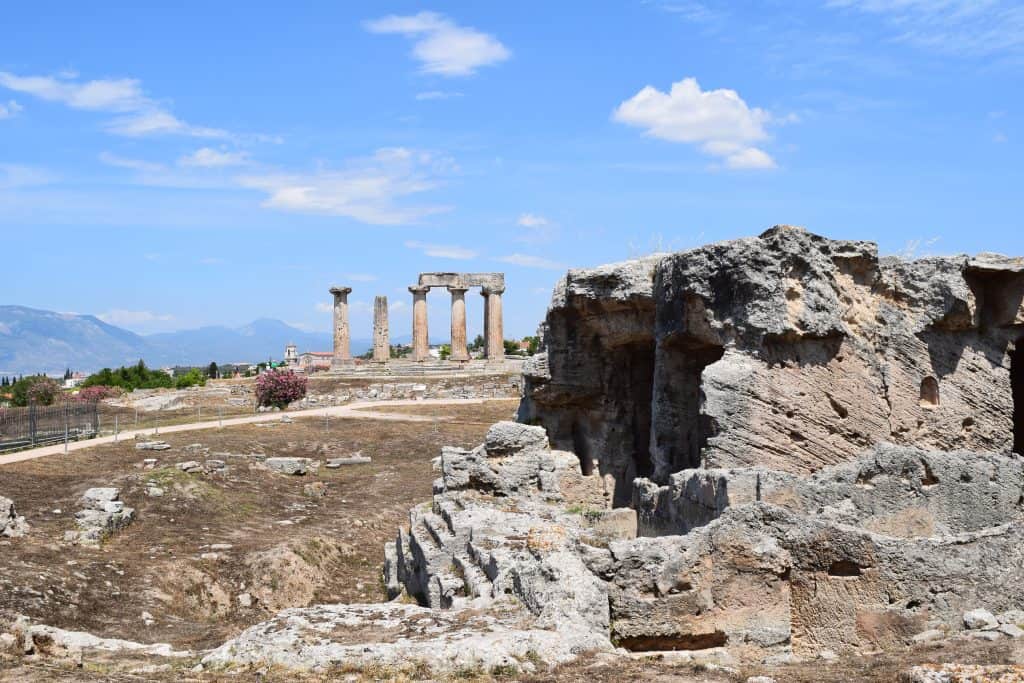
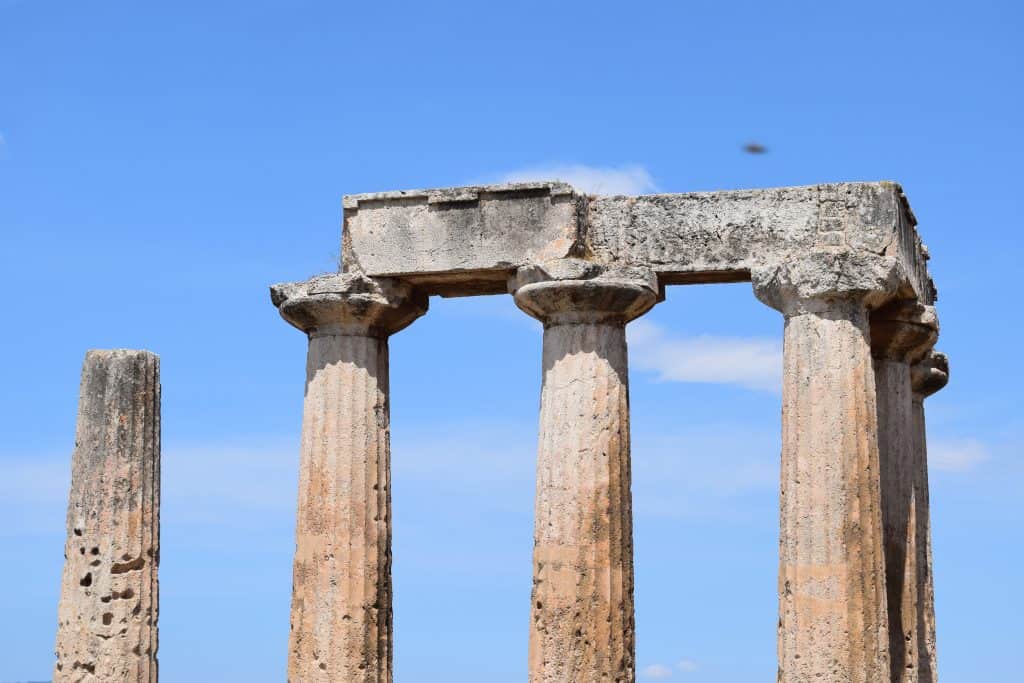
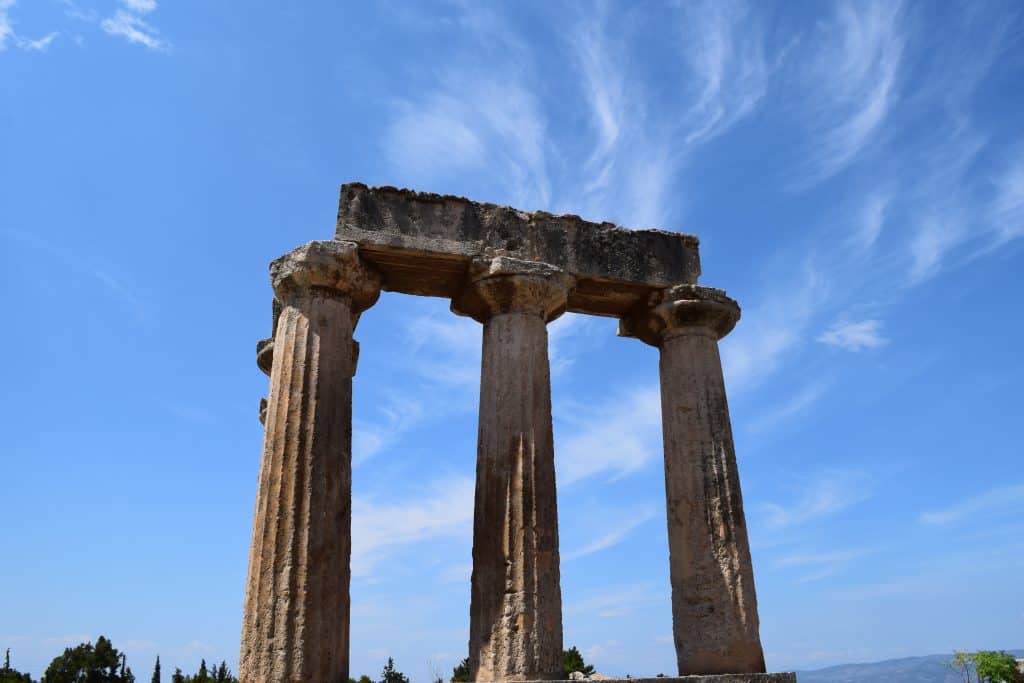
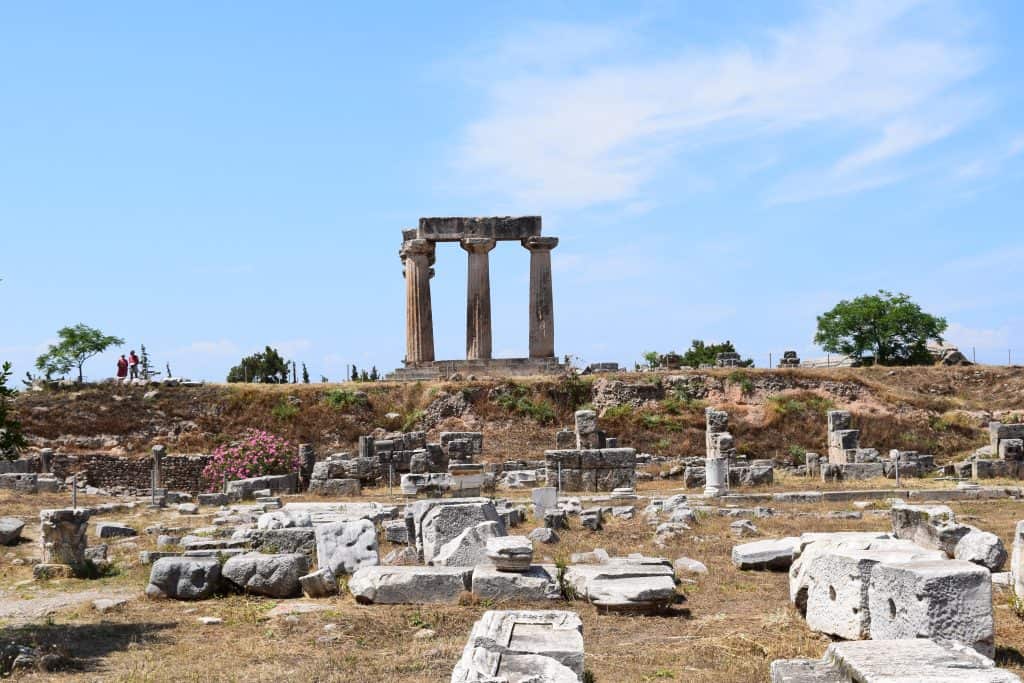
The Temple of Apollo is the most famous and visually striking landmark of Ancient Corinth. It was built around 560 BC in the Doric style, and it is one of the earliest examples of its kind in the Peloponnese. The temple was originally surrounded by 42 monolithic limestone columns. Today, only seven of these impressive columns are still standing, but they create a powerful and iconic image against the backdrop of the Acrocorinth hill. The temple is a testament to the wealth and power of Corinth during its archaic golden age.
The Roman Forum
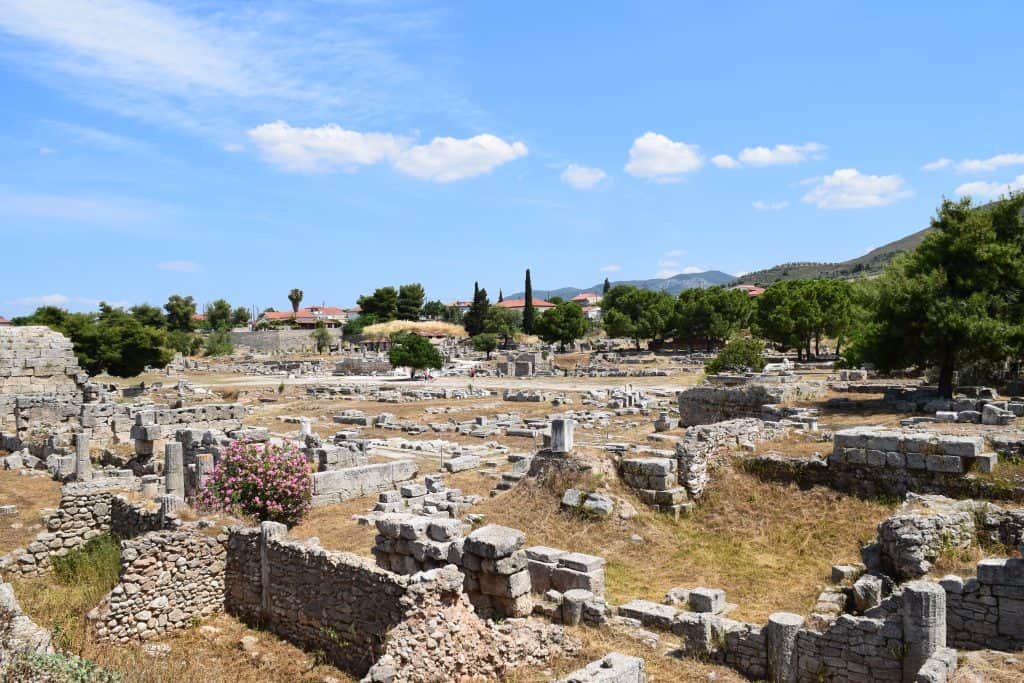
The archaeological site is dominated by the extensive remains of the large Roman Forum. This was the political, commercial, and social heart of the Roman city. The forum was surrounded by a variety of public buildings, including temples, basilicas, and shops. The remains of the starting gates for a Roman-era racetrack can also be seen. A walk through the forum provides a vivid impression of the layout and the public life of a major Roman provincial capital.
The Bema of St. Paul
Located on the edge of the Roman Forum is a large, elevated stone platform known as the Bema. This was the public platform where Roman officials would address the citizens and preside over legal cases. This particular bema is of great historical significance because it is believed to be the very spot where the Apostle Paul was brought to trial before the Roman proconsul Gallio in the 1st century AD. This event is described in the Acts of the Apostles in the New Testament, making the bema a major pilgrimage site for Christians from all over the world.
The Fountain of Peirene
The Fountain of Peirene was the main source of water for the ancient city of Corinth for centuries. The spring is associated with many Greek myths, and it was said to have been created by the hoof of the winged horse Pegasus. The fountain was elaborately decorated in the Roman period with a large courtyard and arches. The water was channeled into a series of underground reservoirs and draw-basins. The impressive remains of this monumental fountain complex are a key sight in the archaeological park.
Archaeological Museum of Ancient Corinth
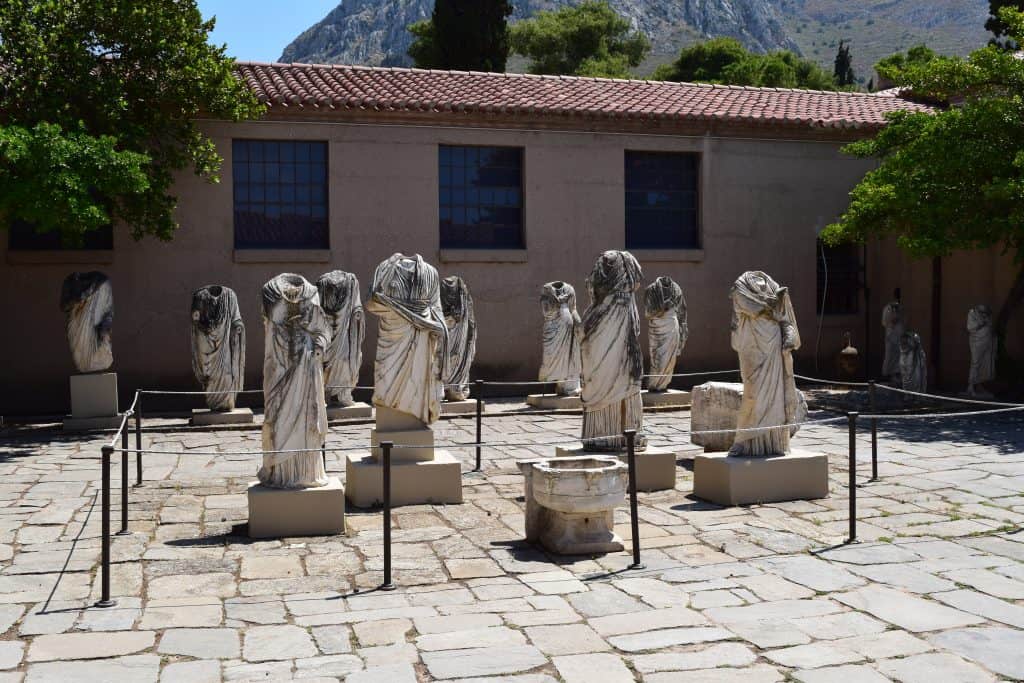
The Archaeological Museum of Ancient Corinth is located directly within the archaeological site. It is one of the most important regional museums in Greece. The museum houses the extensive collection of artifacts that have been unearthed during the long history of excavations at the site. The collections cover the entire history of the city, from the prehistoric period to the medieval era. Highlights of the museum include a large collection of Corinthian pottery, Roman mosaics and sculptures, and the famous Twin Kouroi statues.
Traveling with Kids
A visit to Archaia Korinthos can be a fantastic adventure for families with children, especially those who enjoy history and exploration. The vast archaeological site is like a giant open-air playground where kids can run freely among the ancient ruins. The impressive columns of the Temple of Apollo and the vast open space of the Roman forum can spark a child’s imagination about the ancient world. The story of St. Paul and the legends of Pegasus also provide great storytelling opportunities.
For a different kind of adventure, the nearby fortress of Acrocorinth offers a real-life castle to explore, with spectacular views. The modern city of Corinth on the coast has a pleasant waterfront with playgrounds. This combination of world-class historical sites and accessible recreational spaces makes the Corinth area a well-rounded destination for a family vacation.

Getting Around in Archaia Korinthos
Navigating the area of Archaia Korinthos involves a few different methods. The main archaeological site is explored entirely on foot, but reaching the nearby fortress of Acrocorinth requires transport. A local bus service connects the ancient site with the modern city of Corinth. For maximum flexibility, a car or a taxi is the most practical option, especially for accessing the high acropolis. This combination of options allows visitors to effectively explore all the key sights in the immediate vicinity.
Exploring by Foot
Once you are at the archaeological site of Ancient Corinth, walking is the only way to get around. The main area of the Roman Forum is relatively flat, and it is easy to walk through. The on-site museum is also located directly within the archaeological park. The modern village of Archaia Korinthos, with its cafes and restaurants, is also a pleasant place for a stroll. The walk up to the fortress of Acrocorinth is very steep and long, so it is recommended only for serious hikers who are well-prepared.


How to Get to Archaia Korinthos?
Archaia Korinthos is located in the Peloponnese region of Greece, just a few kilometers southwest of the modern city of Corinth. The site is very easy to reach, as it is located very close to the main motorway that connects the capital city, Athens, with the Peloponnese. The primary gateway for international visitors is Athens International Airport. From Athens, Ancient Corinth can be easily reached by car or by a combination of public transport.
Arriving by Air
The closest and most convenient airport is Athens International Airport (ATH). This is the largest and busiest airport in Greece, and it is served by numerous airlines with connections to destinations all over the world. The airport is located about a 1.5-hour drive from Ancient Corinth. From the airport, you can rent a car and drive directly to the site. It is also possible to take a suburban train or a bus from the airport to the city of Corinth.
Driving to the Site
Driving to Ancient Corinth is very straightforward. The site is located just a few kilometers from the main A8 motorway (Olympia Odos). This is the main highway that connects Athens with the city of Patras in the western Peloponnese. You take the exit for Ancient Corinth and then follow the signs to the archaeological site. The roads are well-maintained and the signage is clear.
Journey by Rail
It is also possible to reach the area by train. The suburban railway, the Proastiakos, runs from Athens International Airport and the main railway station in Athens to the city of Kiato. You would get off at the station for the modern city of Corinth. From the train station in Corinth, you would then need to take a short taxi ride or a local bus to the village and archaeological site of Ancient Corinth.
Connecting by Bus
Long-distance buses, known as KTEL, are another excellent option for reaching the area. There are very frequent and comfortable bus services from the Kifissos Bus Terminal in Athens to the modern city of Corinth. The journey takes about one and a half hours. From the bus station in Corinth, you can then connect to the local bus service that runs to the archaeological site of Ancient Corinth.
Driving Distances
The driving distance from 20 regional cities, according to Google Maps:
- Corinth, Greece – 8 kilometers (0 h 15 min)
- Nafplio, Greece – 50 kilometers (0 h 50 min)
- Tripoli, Greece – 80 kilometers (1 h 00 min)
- Athens, Greece – 85 kilometers (1 h 10 min)
- Patras, Greece – 130 kilometers (1 h 30 min)
- Sparta, Greece – 140 kilometers (1 h 50 min)
- Olympia, Greece – 190 kilometers (2 h 20 min)
- Ioannina, Greece – 340 kilometers (3 h 30 min)
- Tirana, Albania – 550 kilometers (6 h 30 min)
- Thessaloniki, Greece – 580 kilometers (5 h 40 min)
- Skopje, North Macedonia – 660 kilometers (6 h 40 min)
- Podgorica, Montenegro – 750 kilometers (10 h 00 min)
- Sofia, Bulgaria – 850 kilometers (8 h 30 min)
- Sarajevo, Bosnia and Herzegovina – 950 kilometers (12 h 00 min)
- Belgrade, Serbia – 1100 kilometers (11 h 00 min)
- Istanbul, Turkey – 1150 kilometers (12 h 00 min)
- Zagreb, Croatia – 1250 kilometers (12 h 30 min)
- Rome, Italy – 1300 kilometers (plus ferry)
- Budapest, Hungary – 1350 kilometers (13 h 30 min)
- Ljubljana, Slovenia – 1400 kilometers (14 h 00 min)
Looking to Explore more of Greece and Europe?