
Château de Malbrouck, Lorraine | Exploring France
Château de Malbrouck is a restored castle located in the commune of Manderen-Ritzing, in the Moselle department of northeastern France. It is part of the Grand Est region. The castle is positioned near the borders of Luxembourg, which is about 5 kilometers away, and Germany, around 10 kilometers away. The fortress overlooks the Pays de Sierck, a region in what is known as the “Land of the Three Borders.” The castle’s popular name is derived from John Churchill, 1st Duke of Marlborough, who was known locally as “Malbrouck.”
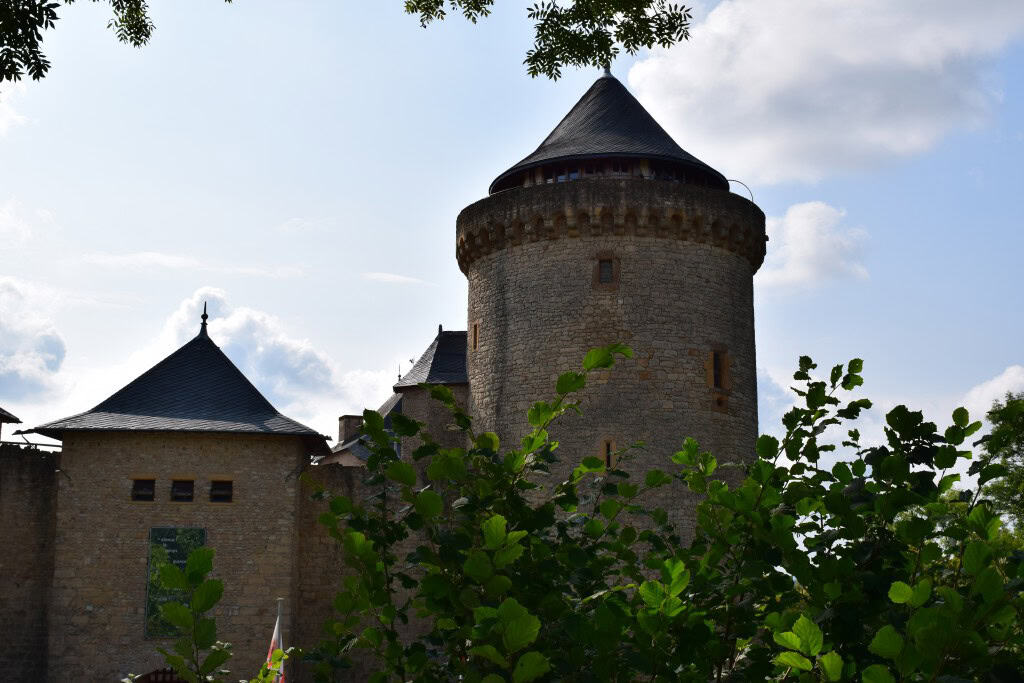
The character of the castle is defined by its well-preserved late medieval architecture and its modern function as a major cultural center for the Moselle department. It is a rare example of a 15th-century fortified lordly residence in the region. The extensive restoration in the late 20th century has made all parts of the castle accessible. Today, it combines its role as a historical monument with that of a venue for high-quality temporary exhibitions, concerts, and events. Its location provides expansive views over the surrounding countryside of France, Germany, and Luxembourg.
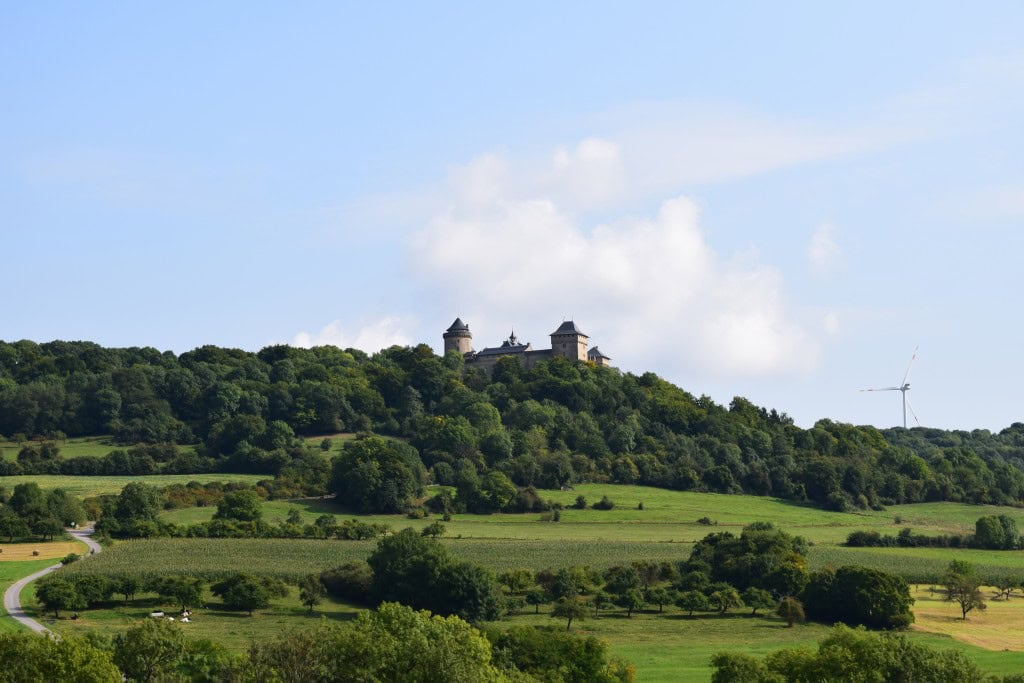
A Short History of Château de Malbrouck
The history of Château de Malbrouck is that of a powerful medieval fortress that fell into ruin and was later brought back to life through one of the most significant restoration projects in the region. The castle’s story begins in the 15th century as a key stronghold for a local lord. It later gained its famous name from a brief, but historically significant, military campaign. After centuries of neglect, its meticulous reconstruction in the modern era transformed it into a major cultural and tourist destination. This journey reflects the changing fortunes of the Lorraine region.
Foundation by Arnold VI de Sierck
The history of Château de Malbrouck begins in the late 15th century. The castle was built between 1419 and 1434 by Arnold VI of Sierck, a powerful local lord and a knight of the Holy Roman Empire. The castle, originally named Meinsberg Castle, was conceived as both a luxurious residence and a strong defensive structure. It showcases a blend of late medieval and early Renaissance architecture. The structure was designed with four prominent corner towers, a large central courtyard, and extensive defensive features. After Arnold’s death, the castle passed through the hands of various noble families over the centuries.
The Duke of Marlborough and a New Name
By the 18th century, the castle had largely fallen into disrepair and was no longer a primary residence for a noble family. It became a symbol of decay in the landscape. Its current popular name, “Malbrouck,” derives from the famous French folk song “Marlbrough s’en va-t-en guerre” (“Marlborough is going to war”). This song became associated with the castle after John Churchill, the 1st Duke of Marlborough, established his headquarters here in 1705. He was preparing for an invasion of France during the War of the Spanish Succession, though the campaign was ultimately called off. Despite his brief stay, his formidable reputation left a lasting mark on the local memory, and the castle became known as Malbrouck’s Castle.
Modern Restoration
For over two centuries after Marlborough’s campaign, the castle remained a ruin. In the 20th century, it was recognized for its historical and architectural importance. A massive restoration project began in 1989, spearheaded by the General Council of Moselle, which had acquired the property. The restoration was an extensive and ambitious undertaking that lasted for nearly a decade. After a significant investment, the castle was fully restored and reopened to the public in 1998. This project ensured the preservation of this key heritage site for future generations, transforming it into the cultural venue it is today.


Things to Do and See
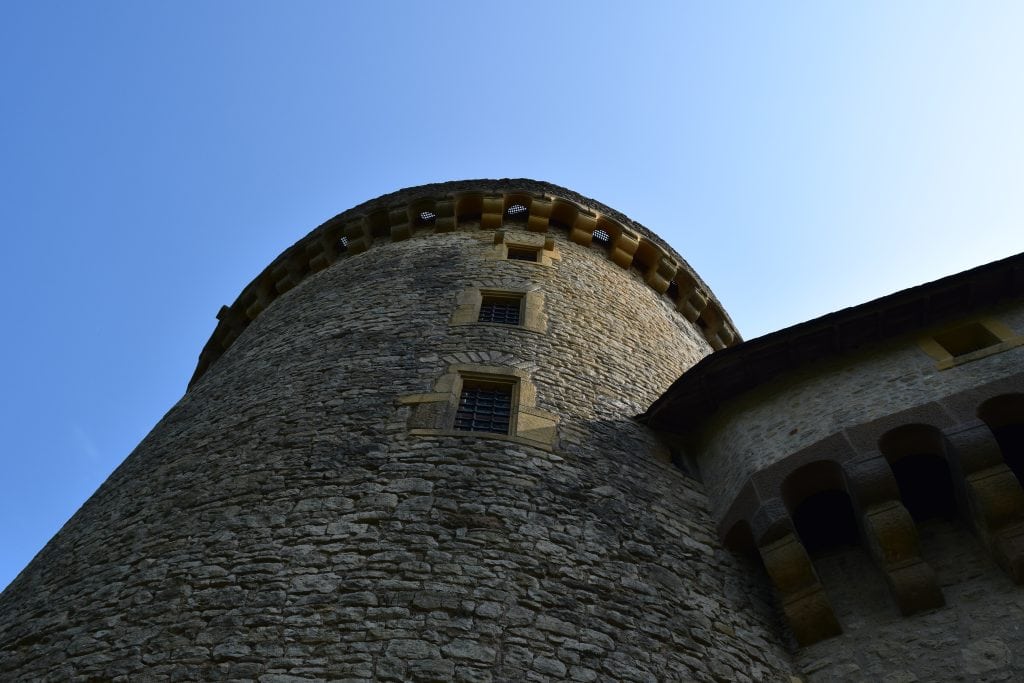
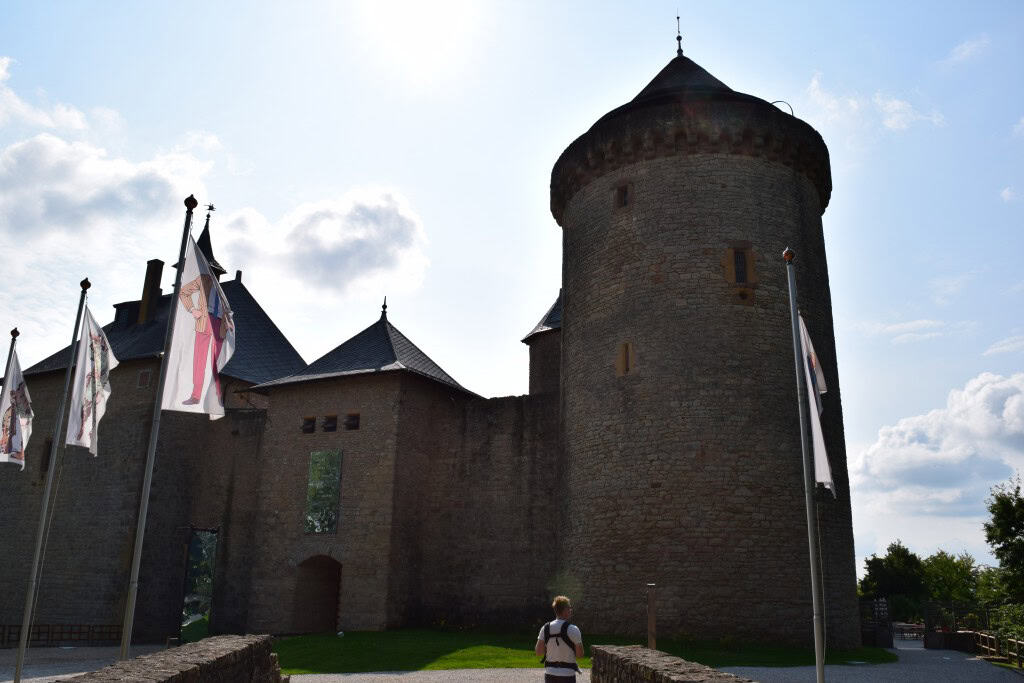
A visit to the Château de Malbrouck offers an experience of an authentic and fully restored medieval fortress. The castle is a rare example of late 15th-century residential and defensive architecture. It features a unique, asymmetrical layout, which is defined by its four imposing circular towers, each with its own name and character: the Witches’ Tower, the Lantern Tower, the Ladies’ Tower, and the Tower of the Hot Stones. Exploring its extensive ramparts, inner courtyards, and various levels allows for an appreciation of the meticulous restoration work.
Beyond its historical structure, Château de Malbrouck hosts high-quality temporary exhibitions, often focusing on art, history, or major cultural themes. These exhibitions utilize the castle’s renovated interior spaces. From the castle’s elevated position and its towers, visitors can enjoy panoramic views of the surrounding countryside, stretching across the Moselle valley and into neighboring Luxembourg and Germany.

How to Get to Château de Malbrouck
Reaching Château de Malbrouck requires travel to a rural part of the Moselle department in northeastern France. The castle is located in the small commune of Manderen-Ritzing. While direct major transport links are limited, connecting via larger hubs in France, Germany, or Luxembourg makes the journey accessible. A car is the most recommended means of transport for visiting the castle.
The Open Road: Driving to the Castle
Driving to Château de Malbrouck is often the most flexible option, as it allows for easy access to the castle and the surrounding rural area. The castle is located near major European road networks. From France, you would take the A31 motorway towards Thionville, and then follow local roads towards Manderen-Ritzing. From Germany, the A8 motorway towards Schengen and Perl provides access. While from Luxembourg, the A13 motorway leads to Schengen. The drive from Metz is approximately 45 minutes. Free parking is available near the castle.
Arriving by Air: Nearby Gateways
Château de Malbrouck does not have its own airport. Several international airports are located within a reasonable driving distance. Luxembourg Airport (LUX) is the closest major international hub, located about 35 kilometers away. Other nearby options include Saarbrücken Airport (SCN) in Germany and Metz-Nancy-Lorraine Airport (ETZ) in France. From any of these airports, onward travel requires a rental car or a combination of bus and train services.
Connecting by Coach
Direct long-distance bus services to the small commune of Manderen-Ritzing do not exist. Instead, travelers would typically take a bus from a company like FlixBus to a larger nearby city. The most common connection points would be Thionville in France, Luxembourg City, or Metz. From any of these cities, a rental car or taxi would be the most practical way to complete the final leg of the journey to the castle, as local bus services to the site are very infrequent.
On Track: A Journey by Rail
Château de Malbrouck does not have its own train station. The best approach by train involves arriving at a nearby regional station and then taking a taxi or other transport. The stations at Apach in France and Perl in Germany are the closest, located about a 10-minute drive from the castle. The station at Sierck-les-Bains is also nearby. The city of Thionville is a larger rail hub with more frequent train connections, including high-speed TGV services from Paris. From Thionville, the drive to the castle is about 25 minutes.
Driving Distances
The driving distance from 10 regional cities, according to Google Maps:
- Luxembourg City, Luxembourg – 35 kilometers (0 h 40 min)
- Trier, Germany – 43 kilometers (0 h 40 min)
- Metz, France – 58 kilometers (0 h 50 min)
- Saarbrücken, Germany – 68 kilometers (1 h 00 min)
- Strasbourg, France – 214 kilometers (2 h 30 min)
- Frankfurt, Germany – 222 kilometers (2 h 40 min)
- Cologne, Germany – 227 kilometers (2 h 40 min)
- Brussels, Belgium – 248 kilometers (2 h 50 min)
- Paris, France – 363 kilometers (4 h 00 min)
- Amsterdam, Netherlands – 457 kilometers (5 h 00 min)
Looking to Explore more of France and Europe?