Pustec | Exploring Albania
Pustec, known as Liqenas in Albanian, is a village in Korçë County, southeastern Albania. It serves as the administrative center for the Pustec Municipality. The village is situated on the western shores of the Great Prespa Lake, on a narrow strip of land between the lake and the Mali i Thatë mountain range. The village itself has a population of just over 1,000 residents and is a primary center for the recognized Macedonian minority in Albania.
The character of Pustec is defined by its setting on the shore of an ancient, high-altitude lake and its role as the hub for the surrounding lakeside communities. The village provides a direct look into the local life of the Prespa region, which is distinct from other parts of Albania. Its location within the Prespa National Park, a trans-boundary protected area shared with North Macedonia and Greece, underscores the importance of its natural environment.


A Short History of Pustec
The history of Pustec is that of a small lakeside village that has been part of larger regional and imperial histories for centuries. Its location has placed it within the sphere of influence of major historical powers, including the Bulgarian and Ottoman Empires. Throughout these periods, the village and its surrounding area maintained a distinct Slavic cultural and linguistic identity. The formal recognition of Pustec as an administrative center in the 21st century was a key event in its modern history, solidifying its role for the local Macedonian community.
Medieval Origins and Byzantine Influence
The area around Lake Prespa has been inhabited for centuries, with early Slavic settlements thriving here. During the medieval period, the region was a significant part of the First Bulgarian Empire. The construction of several cave churches during this time indicates its importance. This legacy is seen in the Byzantine-era architectural and artistic influences found in the region. Pustec itself developed as a small settlement of fishermen and farmers on the lake’s shore.
Ottoman Rule and Local Preservation
Following the decline of medieval empires, Pustec and the Prespa region fell under the control of the Ottoman Empire for several centuries. During this long period, the villages around the lake maintained their distinct Slavic Macedonian identity and language. The area’s remote, rural nature and its position on the periphery of the empire allowed it to preserve its local traditions. Life continued to be primarily based on fishing in Lake Prespa and agriculture on the narrow shoreline.
The 20th Century and Modern Role
After the Balkan Wars and the establishment of modern Albania, Pustec became part of the Albanian state. Its location on a three-point border made it a sensitive area throughout the 20th century. After the fall of communism in Albania, the local Macedonian community sought greater cultural and administrative recognition. In 2013, the Albanian government reorganized its administrative divisions, and the Pustec Municipality was formally established with the village of Pustec as its administrative center.


Things to Do and See
The sights of the Pustec region are centered on the natural environment of Lake Prespa and the historical landmarks found on its shores and islands. The entire area is part of the Prespa National Park, which protects the region’s significant biodiversity and cultural monuments. The main points of interest for visitors are the ancient lake itself, the historic churches carved into its cliffs, and the surrounding mountain landscape. These sights offer a combination of natural and cultural heritage. This makes the region a destination for those interested in history and nature.
Lake Prespa
The Great Prespa Lake (Liqeni i Prespës) is an ancient tectonic lake, shared by Albania, North Macedonia, and Greece. It is one of the oldest lakes in the world, with a maximum depth of 54 meters. Its waters are known for their clarity and for hosting a number of rare endemic fish species. The Albanian portion of the lake is part of the Prespa National Park. The lake’s surface elevation is approximately 853 meters, making it one of the highest tectonic lakes in Europe.
Maligrad Island
Maligrad Island (Ishulli i Maligradit) is a small island located within the Albanian part of Lake Prespa. The island is known for its many caves and for the historic Church of St. Mary, which is built inside one of these caves. The church dates back to 1369. Its interior walls contain frescoes and inscriptions that are important examples of Byzantine-era art. The island is accessible by boat from the shores of the lake and is a key historical site within the national park.
Church of St. Michael
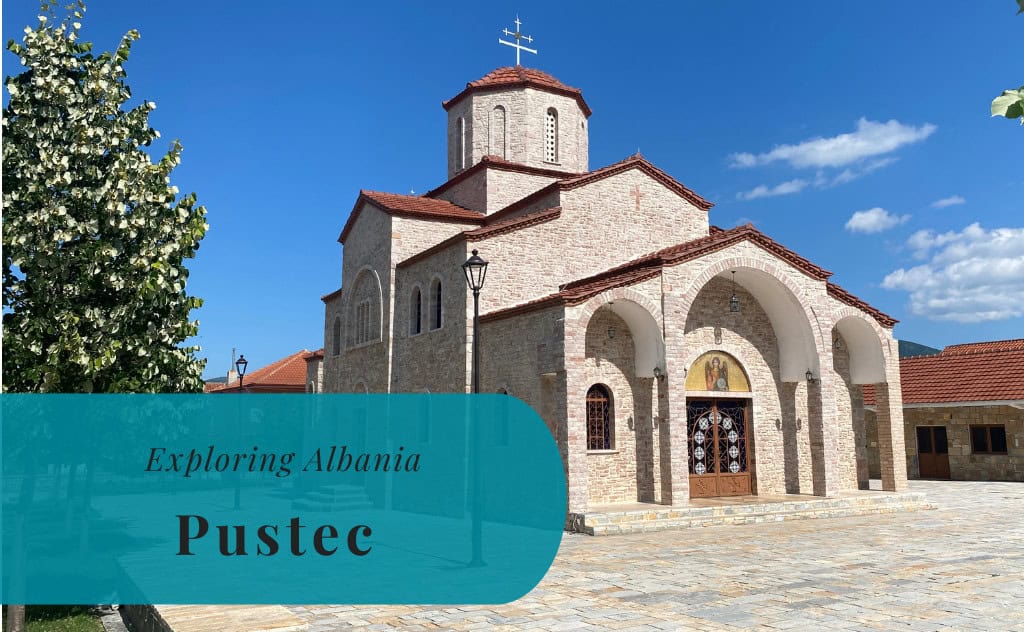
The Church of St. Michael the Archangel (Kisha e Shën Mëhillit) is the main parish church located in the center of the village of Pustec. This is a modern building, constructed in the early 2000s. It was built on the site of an older church that dated back to 1754 but was later destroyed. The new church, with its traditional Orthodox design and bell tower, now serves as the primary spiritual and community center for the village residents. Its presence in the heart of Pustec highlights the continuity of the Orthodox faith in the region.
Mali i Thatë National Park
The mountain range bordering Pustec to the west is the Mali i Thatë, which means “Dry Mountain.” Much of this range is protected as part of the Prespa National Park. The mountains offer a rugged landscape that contrasts with the lake. The park is home to diverse flora and fauna, including large mammals like brown bears and wolves. Hiking trails are available for those wishing to explore the mountain environment.


How to Get to Pustec
Reaching Pustec requires travel to the remote Prespa basin in southeastern Albania. The journey typically involves connecting through the regional capital of Korçë. The most practical way to access the area is by car, as public transport links are limited.
The Open Road: Driving to Prespa
Driving offers the most flexibility for visiting Pustec and exploring the surrounding national park. From the Albanian capital of Tirana, the route involves driving towards Korçë and then taking a smaller mountain road up to the Prespa basin. From Korçë, the drive to Pustec is approximately 40 kilometers. The roads leading to the area are paved but can be winding.
Arriving by Air: Nearby Gateways
There are no major airports in the immediate vicinity of Pustec. The two closest international airports are Ohrid St. Paul the Apostle Airport (OHD) in North Macedonia and Kastoria National Airport (KSO) in Greece. Tirana International Airport (TIA) is Albania’s main hub, but it is a several-hour drive away. From any of these airports, a rental car or a combination of buses and taxis is required to reach Pustec.
Connecting by Coach: A Regional Journey
There are no direct long-distance bus services to Pustec. Travelers must first take a bus to the city of Korçë, which is well-connected to Tirana and other major Albanian cities. From the Korçë bus terminal, local mini-buses (furgons) make the journey to Pustec. These services may not run on a fixed schedule, so it is advisable to check locally for departure times.
Driving Distances
The driving distance from 10 regional cities, according to Google Maps:
- Tirana, Albania – 163 kilometers (2 h 50 min)
- Durrës, Albania – 198 kilometers (3 h 10 min)
- Sarandë, Albania – 223 kilometers (4 h 20 min)
- Thessaloniki, Greece – 250 kilometers (3 h 00 min)
- Skopje, North Macedonia – 251 kilometers (4 h 00 min)
- Vlorë, Albania – 256 kilometers (4 h 00 min)
- Shkodër, Albania – 260 kilometers (4 h 10 min)
- Podgorica, Montenegro – 319 kilometers (5 h 00 min)
- Pristina, Kosovo – 334 kilometers (4 h 40 min)
- Sofia, Bulgaria – 540 kilometers (6 h 20 min)
Looking to Explore more of Albania and Europe?