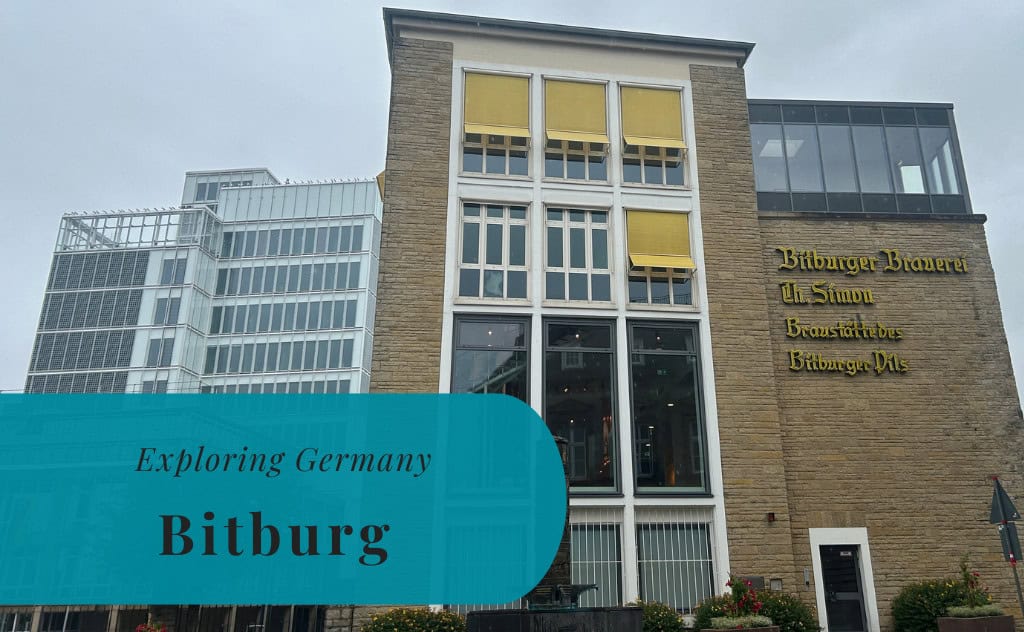
Bitburg, Rhineland-Palatinate | Exploring Germany
Bitburg is a town in the Eifelkreis Bitburg-Prüm district, located in the state of Rhineland-Palatinate, Germany. The town is situated in the Southern Eifel region, a landscape of rolling hills and river valleys. With a population of approximately 17,000 residents, Bitburg serves as the administrative, commercial, and cultural center for its district. It is located about 30 kilometers north of Trier and is very close to the border with Luxembourg, making it a key town in the cross-border region.
The character of Bitburg is defined by its global recognition as the home of the Bitburger brewery. The brewery is one of Germany’s most famous beer brands and a major employer in the town. This industrial heritage exists alongside a deep history that dates back to the Roman Empire. The town’s modern history was also significantly shaped by the long-term presence of a major American military air base. This left a lasting cultural mark on the region. The town today is a blend of this brewing tradition, its ancient past, and its modern role as a regional hub.


A Short History of Bitburg
The history of Bitburg is that of a strategic Roman settlement that evolved into a medieval town and later into a modern administrative and industrial center. Its location on a key transport route between major Roman cities established its early importance. For centuries, it was a fortified town that passed between the hands of various European powers. The 20th century brought both destruction and a new period of international influence with the arrival of the American military, followed by its reinvention after the Cold War.
The Roman Road Station of Beda
The history of Bitburg began as the Roman road station of Vicus Beda. It was founded around the 1st or 2nd century AD. The settlement was located on the important Roman road that connected Lyon, Metz, and Trier with Cologne. This strategic position made it a key logistical and commercial point. The original settlement was later fortified in the 4th century with a large stone wall and towers, the remnants of which can still be seen today. Beda was a significant settlement in the Roman province of Gallia Belgica.
A Medieval Town
After the fall of the Roman Empire, the area was settled by the Franks. The town, now known as Bitburg, developed throughout the Middle Ages. It was granted its town charter in 1262 by Henry V, Count of Luxembourg. For much of its medieval history, Bitburg was part of the County of Luxembourg and later the Duchy of Burgundy and the Habsburg Netherlands. Its location near the border of the Electorate of Trier meant it was often involved in regional conflicts.
The 20th Century and the American Presence
The 20th century brought profound changes to Bitburg. The town was heavily damaged by bombing raids during World War II, with over 85% of it being destroyed. After the war, it was rebuilt. A key development in its modern history was the establishment of Bitburg Air Base in the 1950s. This was a major frontline base for the United States Air Force and later NATO during the Cold War. The presence of thousands of American service members and their families had a significant economic and cultural impact on the town for over four decades, until the base was closed in the 1990s.


Things to Do and See
The sights in Bitburg reflect its Roman origins, its brewing heritage, and its modern role as a regional center. The main points of interest are concentrated in the town center and include the brewery’s visitor center, a major regional museum, and the remnants of the town’s ancient past. The surrounding Eifel region also provides numerous opportunities for outdoor recreation, with marked trails for hiking and cycling.
Bitburger Brewery and Brand World
The Bitburger Brewery (Bitburger Brauerei) is the most significant landmark and institution in the town. Founded in 1817, it is one of Germany’s largest private breweries. Its pilsner beer is known internationally. While the main production facility is not open for general tours, the company operates a large visitor center in the town center called the Bitburger Erlebniswelt (Bitburger Brand World). This modern exhibition takes visitors on an interactive journey through the history of the brewery and the art of beer making. The tour concludes with a beer tasting in the lounge area.
Kreismuseum Bitburg-Prüm
The Kreismuseum Bitburg-Prüm is the local district museum. It is housed in a historic building that was formerly an agricultural school, located in the center of the town. The museum’s exhibitions showcase the history of the Eifelkreis district, from its prehistoric and Roman origins to the modern era. The collections include archaeological finds, historical documents, and extensive displays on the rural life and traditions of the Eifel region. The museum provides a comprehensive overview of the cultural heritage of the area. It is a key institution for preserving the history of the wider Eifel region.
Cascade Water Park
The Cascade is a large, modern indoor and outdoor water park and wellness center located in Bitburg. It is a major recreational facility for the entire region. The complex features numerous swimming pools, including a lap pool, an adventure pool with slides, and an outdoor pool. It also has an extensive sauna and wellness area with several different types of saunas and steam rooms. The Cascade is a popular destination for families and for those seeking leisure and relaxation. It is a central part of the town’s recreational infrastructure.
Roman Mosaics and Beda Wall
Remnants of Bitburg’s Roman past as Vicus Beda are visible in the town center. A key site is a large, well-preserved Roman mosaic from a 2nd-century villa, which is protected under a modern glass structure in a public park. In other parts of the town, sections of the massive stone wall from the 4th-century Roman fort can still be seen. These archaeological sites provide a direct link to the town’s ancient origins as an important Roman settlement on a major trade route. The local tourist office can provide a map showing the locations of these Roman remains.
Nimstal Cycle Path
The Nimstal Cycle Path (Nimstal-Radweg) is a popular recreational route that runs through the region near Bitburg. The path follows the course of the Nims River, a tributary of the Prüm. The cycle path offers a scenic journey through the rolling hills and forests of the Southern Eifel. It connects several small villages and towns in the area. This route is part of the wider network of cycling paths in the Eifel region. It provides a way to explore the natural landscape surrounding the town.
Sports in Bitburg
The sporting life in Bitburg is focused on its local community clubs. These organizations provide opportunities for residents of all ages to participate in a variety of sports. The most popular and widely followed sport in the town is football. The main local club plays a significant role in the social fabric of the community. Its facilities serve as a hub for both training and local league competitions throughout the year.
Football
Football is the primary organized sport in Bitburg, with a local club that has a long history in the town. The sport has a dedicated following among local residents, who support their team. The main club provides a platform for local talent to develop. It also serves as an important focus for community identity and pride. The club is a key institution for youth sports in the city.
FC Bitburg
The town’s main football club is FC Bitburg. The club has a long history, founded in 1919. The senior football team competes in the regional leagues of Rhineland-Palatinate, such as the Rheinlandliga. They play their home games at the Stadion am Ostring, a local sports ground with a grass pitch and a running track. The club has an extensive youth program that provides training and competition for hundreds of young players from the local community.


Getting Around in Bitburg
Navigating the town of Bitburg is straightforward due to its compact size. The city center is highly walkable, making it easy for visitors to explore the main sights on foot. For travel to the surrounding areas, a network of regional buses is the primary mode of public transport. A car can be useful for exploring the wider Eifel region. The town is designed with a central pedestrian zone, which enhances the walking experience for both residents and visitors. Local transport is managed by the regional transport authority, ensuring integrated ticketing with nearby cities like Trier.
On Foot: The Town Center
Walking is the best way to explore the central part of Bitburg. The main pedestrian shopping zone, the brewery’s visitor center, the museum, and the Roman ruins are all located within a short walking distance of each other. This allows visitors to see the town’s main sights at a relaxed pace. The town center is relatively flat, making it easy to navigate. Comfortable shoes are recommended for exploring the historic areas.
Local Buses
The public transport in the region is operated by the Verkehrsverbund Region Trier (VRT). A network of regional buses connects Bitburg with the surrounding villages and with larger nearby cities like Trier. These buses are the primary mode of public transport for traveling within the Eifelkreis district. The main bus station is located in the town center, serving as a hub for the various routes. The services are a key transport link for local residents.
On Two Wheels: Cycling in the Eifel
Cycling is a very popular way to explore the scenic Eifel region surrounding Bitburg. The area features an extensive network of well-marked cycle paths (Radwege) that often run along former railway lines or through river valleys. The Nimstal Cycle Path is a key route that passes near the town, offering a gentle journey through the Nims River valley. While the town center is small and walkable, a bicycle is an excellent way to reach nearby villages and natural attractions. Bike rentals are available in the region.
How to Get to Bitburg
Reaching Bitburg is convenient by road due to its proximity to the motorway network. The town is located in a rural region of western Germany, near the border with Luxembourg, making it accessible from several countries. Its location in the heart of the Eifel makes it a good base for exploring the region. The primary modes of transport for reaching the town are by car or by a combination of train and bus via nearby hubs.
The Open Road: Driving the Autobahn
Driving is the most practical way to reach Bitburg. The town is located directly on the A60 motorway (Autobahn). This highway connects to the main A1 motorway, which provides a direct link to Cologne in the north and Trier in the south. The B51 federal road also runs directly through the town, connecting it with Trier. This makes Bitburg highly accessible by car from Germany, Luxembourg, and Belgium. There is public parking available in the town center.
Arriving by Air: Nearby Gateways
The closest and most convenient major international airport is Luxembourg Airport (LUX), located approximately 40 kilometers away. Another nearby option is Frankfurt-Hahn Airport (HHN), which is primarily served by low-cost carriers and is about 60 kilometers away. From either of these airports, a rental car is the most practical option for completing the journey to Bitburg. Public transport connections from these airports would typically require multiple transfers.
Connecting by Coach
There are limited direct long-distance bus services to Bitburg itself. Travel by coach would typically involve taking a service from a company like FlixBus to a larger nearby city, such as Trier or Luxembourg City. From these cities, travelers would then need to transfer to a regional bus service operated by the VRT to complete the journey to Bitburg. This can be an economical option, but it requires careful planning of connections.
On Track: A Journey by Rail
Bitburg does not have its own main line train station in the town center. The closest station is Bitburg-Erdorf, which is located about 5 kilometers outside the town. This station is on a small branch line that connects to the main Eifel line at Gerolstein. A more practical option for train travel is to arrive at the main station in Trier. Trier Hauptbahnhof has frequent connections to major German cities. From Trier, frequent regional bus services connect to Bitburg.
Driving Distances
The driving distance from 10 regional cities, according to Google Maps:
- Trier, Germany – 30 kilometers (0 h 30 min)
- Luxembourg City, Luxembourg – 61 kilometers (0 h 50 min)
- Liège, Belgium – 115 kilometers (1 h 30 min)
- Metz, France – 118 kilometers (1 h 30 min)
- Cologne, Germany – 131 kilometers (1 h 40 min)
- Frankfurt, Germany – 198 kilometers (2 h 20 min)
- Brussels, Belgium – 216 kilometers (2 h 30 min)
- Strasbourg, France – 227 kilometers (2 h 40 min)
- Amsterdam, Netherlands – 352 kilometers (4 h 00 min)
- Paris, France – 419 kilometers (4 h 30 min)
Looking to Explore more of Germany and Europe?